Intimate partner violence against women is all too common and takes many forms. The most serious is homicide by a current or former intimate partner. Guns can easily turn domestic violence into domestic homicide. It has been well established that abuser access to a gun is one of the strongest risk factors of intimate partner violence (IPV)-related homicide.1 2
Studies show that female intimate partners are more likely to be murdered with a firearm compared to other weapons, demonstrating “the importance of reducing access to firearms in households affected by IPV.”3 4 An analysis of female victims of homicides perpetrated by men between 2018 and 2021 found that firearms were the most commonly used weapon and were more commonly used in IPV-related homicides compared to non-IPV related homicides (65 percent compared to 57 percent).5
Guns are also often used in non-fatal domestic violence.6 7 8 A study by Harvard School of Public Health researchers analyzed gun use at home and concluded that “hostile gun displays against family members may be more common than gun use in self-defense, and that hostile gun displays are often acts of domestic violence directed against women.”9
A woman must consider the risks of having a gun in her home, whether she has an abusive partner or not. While two-thirds of women who own guns acquired them “primarily for protection against crime,” the results of a California analysis show that “purchasing a handgun provides no protection against homicide among women and is associated with an increase in their risk for intimate partner homicide.”10 Multiple studies have found that the presence of a firearm in the home increases one’s risk for homicide.11 12 13 14 15
While this study does not focus solely on domestic violence homicide or guns, it provides a stark reminder that domestic violence and guns make a deadly combination. According to crime data from the Federal Bureau of Investigation (FBI), firearms are rarely used to kill in self defense.16 In 2024, for example, for every justifiable homicide in the U.S. involving a gun, guns were used in 31 criminal homicides.17 Out of the 358 justifiable homicides committed with guns that year reported to the FBI, less than 10 percent (33 justifiable homicides) were committed by females shooting and killing males. Instead of guns providing protection, they are all too often used to inflict harm on the very people they were intended to protect.
This study uses 2024 FBI crime data18 as well as data from previous years19 and examines instances involving one female homicide victim and one male offender. This is the exact scenario — the lone male attacker and the vulnerable woman — that is often used by the firearms industry and gun lobby to promote gun ownership among women.
AN IMPORTANT NOTE ABOUT THE DATA
Since 1998, the Violence Policy Center (VPC) has published the annual report When Men Murder Women. The goal of the study is to present the reality of homicides committed by males against females in single victim/single offender incidents and reveal the role played by firearms in these deaths. A key element of the study throughout its 29-year history has been its ranking of the states with the 10 highest rates of females killed by males in single victim/single offender incidents and offering additional homicide victimization information for each of these states.
Unfortunately, in January of 2021, the FBI changed the way crime data are collected and reported, which has impacted the reliability of subsequent data.20 That year, the FBI replaced the previous crime-reporting system with the National Incident-Based Reporting System (NIBRS). While it is expected that NIBRS will eventually provide crime data that is more comprehensive compared to the previous system, transitioning law enforcement agencies to this new data collection and reporting system has been slow and burdensome. As a result, beginning with 2021 data, the VPC has not been able to rank the states or offer state-level information for all 50 states. Given this limitation, in addition to the national findings contained in this report, this year the VPC offered additional findings for the states of Nevada, Oklahoma, South Carolina, and Tennessee. These states were among those for which FBI data are sufficiently robust to allow a more comprehensive analysis and each has a history of high rates of females murdered by males, as well as a strong interest in working to reduce domestic violence. The data for these states can be found in Appendix One.
The Violence Policy Center hopes that at some point in the near future FBI crime data will once again be sufficiently robust to allow for a more complete analysis, including state rankings.
Section One: National Data
In 2024, 2,381 females were killed by males in single victim/single offender incidents.
The rate of women murdered by men in single victim/single offender incidents dropped between 1996 and 2014 (Figure 1). The rate then increased from 1.2 per 100,000 in 2019 to 1.4 in 2022. The rate remained stable between 2023 and 2024 at 1.4 per 100,000.
In 2024, 2,381 females were killed by males in single victim/single offender incidents.
Figure 1. Rate* of females killed by males, 1996 — 202421 22

*Rates are per 100,000 and not adjusted for age
**FBI crime data are not shown for 2021 due to the degree of unreliability of data caused by the initial transition between FBI crime data reporting systems (depicted by grey area of graph)
AGE AND RACE OF FEMALE HOMICIDE VICTIMS
In 2024, for single female victim/single male offender homicides where the age of the victim was reported (2,368 homicides), 7.1 percent of the victims were younger than 18 years old (169 victims) and 13.7 percent were 65 years of age or older (325 victims). The average age of female homicide victims was 41.7 years old. Homicides in which race was identified (2,326 victims) included: 42 American Indian or Alaskan Native females; 73 Asian or Pacific Islander females; 704 Black females; and 1,507 white females.
Overall, Black females were murdered by males at a rate (2.9 per 100,000) more than twice as high as white females (1.2 per 100,000, Figure 2). American Indian and Alaskan Native females (1.8 per 100,000) were murdered by male offenders at a higher rate than white females, while Asian and Pacific Islander females were the least likely (0.6 per 100,000) females of any race to be murdered by a male offender. Nationally, the female homicide victimization rate was 1.4 per 100,000. Unfortunately, Hispanic ethnicity of victims could not be determined on a national level because of the inadequacy of reporting and data collection.
Figure 2. Rate* of females killed by males by race, 1996 — 202423 24
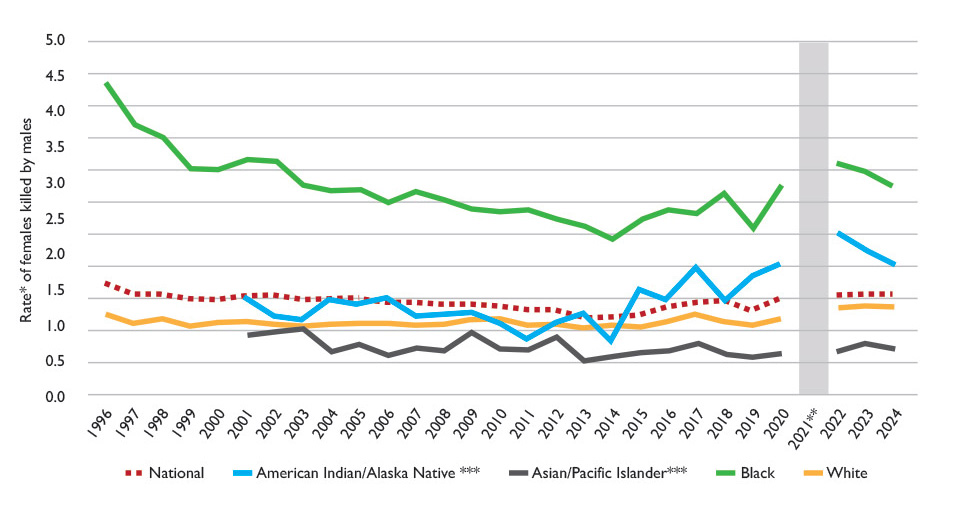
*Rates are per 100,000 and not adjusted for age
**FBI crime data are not shown for 2021 due to the degree of unreliability of data caused by the initial transition between FBI crime data reporting systems (depicted by grey area of graph)
***Race data for American Indian/Alaska Native and Asian/Pacific Islander populations were not reported in VPC’s annual When Men Murder Women reports until 2001. Hispanic ethnicity data are unavailable on a national level due to the inadequacy of data collection and reporting.
VICTIM TO OFFENDER RELATIONSHIP
The relationship of victim to offender differs significantly between male and female victims of homicide. Compared to a man, a woman is far more likely to be killed by her spouse, an intimate acquaintance, or a family member than by a stranger.25
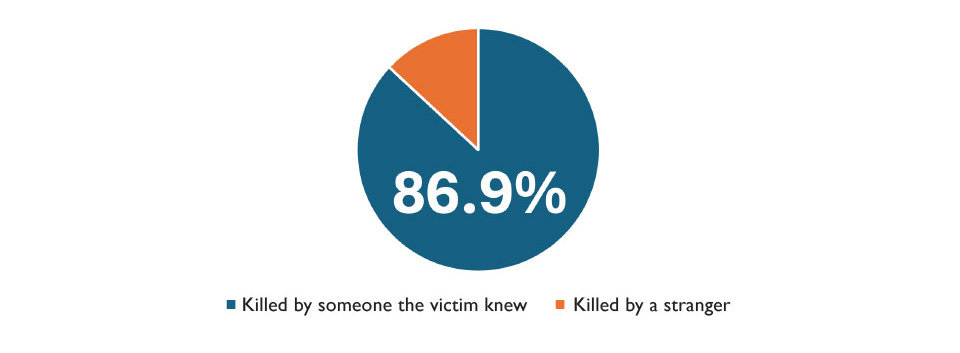
86.9 percent of female victims (1,807 out of 2,079) were murdered by someone they knew.
For homicides in which the victim to offender relationship could be identified, 86.9 percent of female victims (1,807 out of 2,079) were murdered by someone they knew (Figure 3). More than six times as many females were murdered by a male they knew (1,807 victims) than were killed by male strangers (272 victims) in single victim/single offender incidents in 2024. Of victims who knew their offenders, 57.6 percent (1,040 out of 1,807) were wives, common-law wives, ex-wives, or girlfriends of the offenders. (Ex-girlfriends cannot be included in the intimate acquaintance analysis because there is not a separate designation for ex-boyfriends or ex-girlfriends in the relationship category in the crime data.)
Figure 3. Percentage of homicide victims killed by a male they knew, 202426
FEMALE HOMICIDE VICTIMS AND WEAPONS
Firearms were the weapon most commonly used by males to murder females in 2024. For homicides in which the weapon could be identified, 63.4 percent of female victims (1,192 out of 1,879) were killed with a gun. The percentage of females killed by males with a firearm has increased substantially from 51.5 percent in 2011 to 65.6 percent in 2022 before dropping slightly to 63.4 percent in 2024 (Figure 4).
The percentage of females killed by males with a firearm has increased substantially from 51.5 percent in 2011 to 65.6 percent in 2022.
Of the female victims killed with a firearm, 53.8 percent were murdered by male intimates. The number of females shot and killed by their husband or intimate acquaintance (641 victims) was more than two times higher than the total number murdered by male strangers using all weapons combined (272 victims) in single victim/single offender incidents in 2024. In homicides where males used firearms to kill females, handguns were clearly the weapon of choice over rifles and shotguns. In 2024, 60.0 percent of female firearm homicide victims (715 out of 1,192) were killed with handguns.
Figure 4. Percentage of females killed by males with a firearm, 1996 — 202427
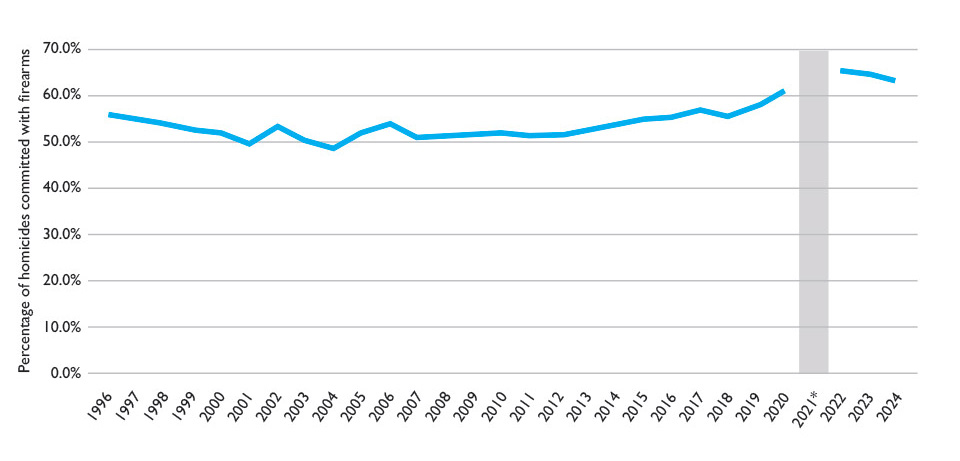
*FBI crime data are not shown for 2021 due to the degree of unreliability of data caused by the initial transition between FBI crime data reporting systems (depicted by grey area of graph)
FEMALE HOMICIDE VICTIMS AND CIRCUMSTANCE
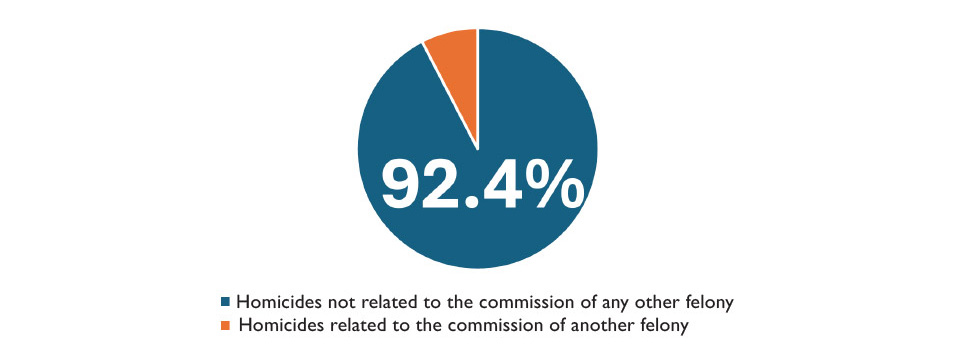
The overwhelming majority of homicides of females by male offenders in single victim/single offender incidents in 2024 were not related to any other felony crime. Most often, females were killed by males in the course of an argument — most frequently with a firearm. In 2024 there were 1,863 incidents in which the circumstances of the homicide between the female victim and male offender in single victim/single offender incidents could be identified. Of these, 92.4 percent (1,721 out of 1,863) were not related to the commission of any other felony (Figure 5).
Figure 5. Percentage of homicides that were not related to the commission of any other felony, 202428
Of the homicides not related to the commission of another felony, 58.4 percent (1,005 out of 1,721) involved arguments between the female victim and male offender. Of homicides stemming from an argument, 61.6 percent (619 out of 1,005) were committed with guns. In 2024 there were 428 women shot and killed by their husbands or intimate acquaintances in single victim/single offender incidents during the course of an argument.
In 2024 there were 428 women shot and killed by their husbands or intimate acquaintances during an argument.
Section Two: Black Females
The disproportionate burden of fatal and nonfatal violence borne by Black females has almost always been overshadowed by the toll lethal violence exacts on Black males. In fact, research has shown that Black women experience a disproportionate burden of homicide compared to their white female counterparts.29 30 31
Research published in 2017 by the federal Centers for Disease Control and Prevention (CDC) found, “Homicides occur in women of all ages and among all races/ethnicities, but young, racial/ethnic minority women are disproportionately affected.”32 The article concluded, “Racial/ethnic differences in female homicide underscore the importance of targeting prevention and intervention efforts to populations at disproportionately high risk. Addressing violence will require an integrated response that considers the influence of larger community and societal factors that make violence more likely to occur.”33
Black females were murdered by males at a rate more than twice as high as white females.
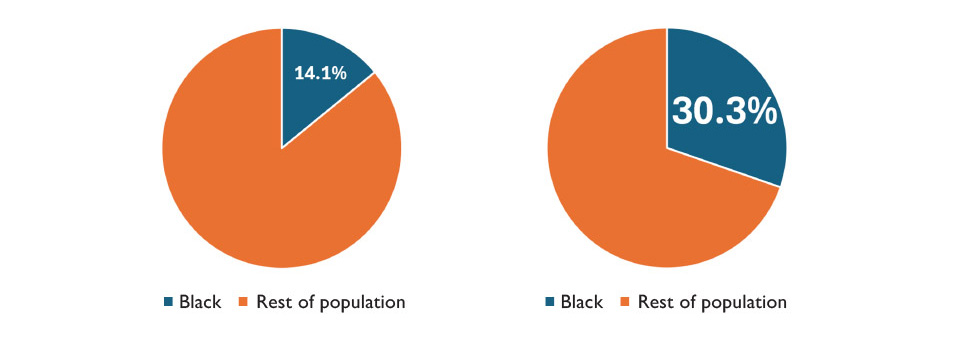
In 2024, 704 Black females were killed by males in single victim/single offender homicides. Black females were murdered by males at a rate more than twice as high as white females: 2.9 per 100,000 versus 1.2 per 100,000. In 2024, Black females accounted for 14.1 percent of the female population in the United States,34 while 30.3 percent of the females killed by males in single victim/single offender incidents where the race of the victim was known were Black (Figure 6).35
Figure 6. Black percentage of United States female population36 (left figure); Black percentage of female homicide victims killed by males37 (right figure), 2024
AGE OF BLACK FEMALE HOMICIDE VICTIMS
In 2024, for single female victim/single male offender homicides with Black victims where the age of the victim was reported (702 homicides), 8.8 percent of Black female victims were less than 18 years old (62 victims) and 5.7 percent were 65 years of age or older (40 victims). The average age of Black female homicide victims was 36.6 years old.
VICTIM TO OFFENDER RELATIONSHIP
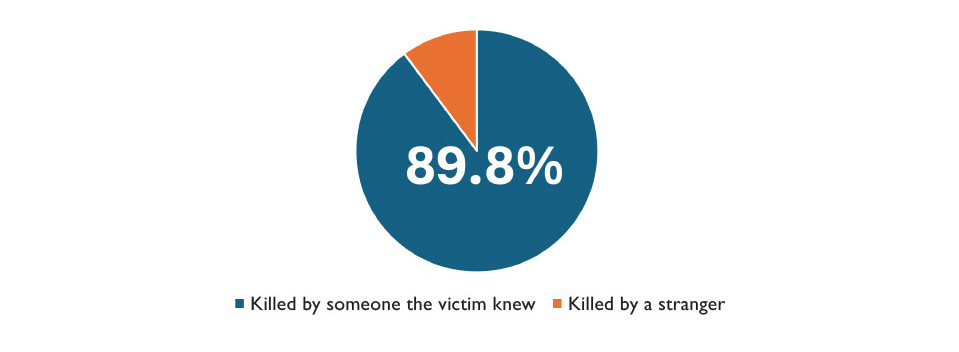
Compared to a Black male, a Black female is far more likely to be killed by her spouse, an intimate acquaintance, or a family member than by a stranger. Where the relationship could be determined, 89.8 percent of Black females killed by males in single victim/single offender incidents knew their killers (530 out of 590, Figure 7). Nearly nine times as many Black females were murdered by a male they knew (530 victims) than were killed by male strangers (60 victims) in single victim/single offender incidents in 2024. Of Black victims who knew their offenders, 53.6 percent (284 out of 530) were wives, common-law wives, ex-wives, or girlfriends of the offenders.
Figure 7. Percentage of Black female homicide victims killed by a male they knew,
202438
BLACK FEMALE HOMICIDE VICTIMS AND WEAPONS
As with female homicide victims in general, firearms were the weapon most commonly used by males to murder Black females in 2024. In the 620 homicides for which the murder weapon could be identified, 76.5 percent of Black female victims (474 victims) were shot and killed with guns. The percentage of Black females killed by males with a firearm has increased substantially from 51.3 percent in 2011 to 77.6 percent in 2022 before decreasing to 76.5 percent in 2024 (Figure 8).
Over the last decade, the disparity in the percentage of females killed by males with a firearm has widened between Black and white women in the United States. In 2015, a similar percentage of Black and white females were killed with firearms — 57.6 percent and 55.5 percent respectively (Figure 8). In 2024, there was a much larger difference — 76.5 percent of Black females killed by males were killed with a firearm compared to 57.7 percent of white females.
The percentage of Black females killed by males with a firearm increased from 57.6 percent in 2015 to 76.5 percent in 2024.
Of the gun homicides committed against Black females, 58.4 percent involved handguns (277 victims). The number of Black females shot and killed by their husband or intimate acquaintance (214 victims) was more than three and a half times as high as the total number murdered by male strangers using all weapons combined (60 victims) in single victim/single offender incidents in 2024.
Figure 8. Percentage of females killed by males with a firearm by race, 1996 — 202439

*FBI crime data are not shown for 2021 due to the degree of unreliability of data caused by the initial transition between FBI crime data reporting systems (depicted by grey area of graph)
BLACK FEMALE HOMICIDE VICTIMS AND CIRCUMSTANCE
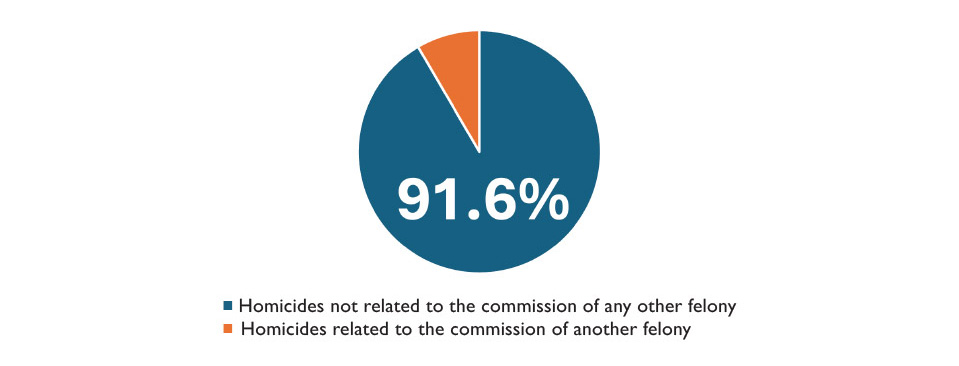
The overwhelming majority of homicides of Black females by male offenders in single victim/single offender incidents in 2024 were not related to any other felony crime. Most often, Black females were killed by males in the course of an argument — most commonly with a firearm. In 2024, for the 487 homicides in which the circumstances between the Black female victim and male offender could be identified, 91.6 percent (446 out of 487) were not related to the commission of any other felony (Figure 9).
Figure 9. Percentage of Black female homicides that were not related to the commission of any other felony, 202440
Two-thirds of non-felony related homicides (301 out of 446) involved arguments between the Black female victim and male offender and 77.7 percent (234 victims) were shot and killed with guns during those arguments. In 2024 there were 143 Black women shot and killed by their husbands or intimate acquaintances in single victim/single offender incidents during the course of an argument.
Section Three: Laws That Help Protect Women From Abusers
The data presented over the years in When Men Murder Women coincide with the initial passage and implementation of the federal Violence Against Women Act (VAWA) as well as the enactment of federal laws restricting firearms possession by persons with misdemeanor convictions for domestic violence or who are subject to certain protective orders for domestic violence.
Since the passage of these laws, domestic violence has increasingly been treated as the serious problem that it is. States have also reformed their laws to better protect victims of domestic abuse and remove firearms from persons with histories of domestic violence.
In the 1990s, two major provisions were added to federal law to prevent domestic abusers from obtaining firearms. In 1993, Senator Paul Wellstone (D-MN) attached an amendment to the Violent Crime Control and Law Enforcement Act to prohibit individuals who are the subject of a protective order involving domestic violence from buying or possessing firearms. The Wellstone amendment became law in 1994.41 (On June 21, 2024, the Supreme Court upheld this longstanding prohibition on the possession of firearms by people subject to domestic violence protective orders in United States v. Rahimi.)
In 1996, Senator Frank Lautenberg (D-NJ) sponsored a provision prohibiting individuals with misdemeanor domestic violence convictions from purchasing or possessing firearms (those with felony domestic violence convictions were already precluded from firearms possession under a general provision prohibiting firearms possession by felons).42
The Violence Against Women Act Reauthorization Act of 2022 was passed by Congress as part of the Omnibus appropriations package and signed into law by President Biden in March 2022. The Bipartisan Safer Communities Act, which also took effect in 2022, expands the prohibition on gun possession by domestic violence misdemeanants to include those in a dating relationship. This prohibition expires after five years if the person is not convicted of another offense. The bill, however, did not extend the prohibited category of persons subject to a final domestic violence protective order to those in a dating relationship.
These laws are enforced in part by the Brady Law background checks performed on firearm transactions conducted through Federal Firearms License (FFL) holders. From November 30, 1998 to July 31, 2026, these two domestic violence prohibited categories accounted for 12 percent of rejected federal firearm transfers.43 However, not all states make the records of domestic violence protective orders and misdemeanors available to the National Instant Criminal Background Check System (NICS), the computer system used to conduct the Brady Law background checks. Moreover, the U.S. Department of Justice has in the past identified several common impediments to thorough checks of domestic violence records: incomplete automation; incomplete records; and, the inability to distinguish domestic violence misdemeanors from other misdemeanors. Moreover, to enhance enforcement of these life-saving measures it is important for states to adopt laws that mirror the federal laws and ensure that guns are surrendered by, or removed from the possession of, abusers.
Conclusion
Many women — those in abusive relationships, those who have left such relationships, those who fear, in general, for their safety — have considered bringing a gun into their home as a measure of protection. Yet, gun ownership contains clear risks that should deeply concern women.
A 2002 study from researchers at the Harvard School of Public Health found that although the United States represented only 32 percent of the female population among 25 high-income countries, it accounted for 84 percent of all female firearm
homicides.44 The study’s lead author, Dr. David Hemenway, concluded that “the difference in female homicide victimization rates between the U.S. and these other industrialized nations is very large and is closely tied to levels of gun ownership. The relationship cannot be explained by differences in urbanization or income inequality.”
The picture that emerges each and every year from When Men Murder Women is that women face the greatest threat from someone they know, most often a spouse or other intimate acquaintance, who is armed with a gun. For women in America, guns are not used to save lives, but to take them.
Appendix One: Additional Findings for Nevada, Oklahoma, South Carolina, and Tennessee
Appendix Two: Data for Figures in the Report
Figure 1. Rate* of females killed by males, 1996 — 202445 46
| National rate* of females killed by males | |
|---|---|
| 1996 | 1.6 |
| 1997 | 1.4 |
| 1998 | 1.4 |
| 1999 | 1.4 |
| 2000 | 1.3 |
| 2001 | 1.4 |
| 2002 | 1.4 |
| 2003 | 1.3 |
| 2004 | 1.3 |
| 2005 | 1.3 |
| 2006 | 1.3 |
| 2007 | 1.3 |
| 2008 | 1.3 |
| 2009 | 1.3 |
| 2010 | 1.2 |
| 2011 | 1.2 |
| 2012 | 1.2 |
| 2013 | 1.1 |
| 2014 | 1.1 |
| 2015 | 1.1 |
| 2016 | 1.2 |
| 2017 | 1.3 |
| 2018 | 1.3 |
| 2019 | 1.2 |
| 2020 | 1.3 |
| 2021** | N/A |
| 2022 | 1.4 |
| 2023 | 1.4 |
| 2024 | 1.4 |
*Rates are per 100,000 and not adjusted for age
**FBI crime data are not shown for 2021 due to the degree of unreliability of data caused by the initial transition between FBI crime data reporting systems
Figure 2. Rate* of females killed by males by race, 1996 — 202447 48
| National | American Indian/Alaska Native** | Asian/Pacific Islander** | Black | White | |
|---|---|---|---|---|---|
| 1996 | 1.6 | N/A | N/A | 4.4 | 1.1 |
| 1997 | 1.4 | N/A | N/A | 3.9 | 1.0 |
| 1998 | 1.4 | N/A | N/A | 3.6 | 1.1 |
| 1999 | 1.4 | N/A | N/A | 3.2 | 1.0 |
| 2000 | 1.3 | N/A | N/A | 3.2 | 1.0 |
| 2001 | 1.4 | 1.4 | 0.8 | 3.3 | 1.1 |
| 2002 | 1.4 | 1.1 | 0.9 | 3.3 | 1.0 |
| 2003 | 1.3 | 1.0 | 0.9 | 3.0 | 1.0 |
| 2004 | 1.3 | 1.3 | 0.6 | 2.9 | 1.0 |
| 2005 | 1.3 | 1.3 | 0.7 | 2.9 | 1.0 |
| 2006 | 1.3 | 1.3 | 0.5 | 2.7 | 1.0 |
| 2007 | 1.3 | 1.1 | 0.6 | 2.9 | 1.0 |
| 2008 | 1.3 | 1.1 | 0.6 | 2.7 | 1.0 |
| 2009 | 1.3 | 1.1 | 0.8 | 2.6 | 1.1 |
| 2010 | 1.2 | 1.0 | 0.6 | 2.6 | 1.1 |
| 2011 | 1.2 | 0.8 | 0.6 | 2.6 | 1.0 |
| 2012 | 1.2 | 1.0 | 0.7 | 2.5 | 1.0 |
| 2013 | 1.1 | 1.1 | 0.4 | 2.4 | 1.0 |
| 2014 | 1.1 | 0.7 | 0.5 | 2.2 | 1.0 |
| 2015 | 1.1 | 1.5 | 0.5 | 2.4 | 1.0 |
| 2016 | 1.2 | 1.3 | 0.6 | 2.6 | 1.0 |
| 2017 | 1.3 | 1.8 | 0.7 | 2.6 | 1.1 |
| 2018 | 1.3 | 1.3 | 0.5 | 2.9 | 1.0 |
| 2019 | 1.2 | 1.7 | 0.5 | 2.3 | 1.0 |
| 2020 | 1.3 | 1.9 | 0.5 | 3.0 | 1.1 |
| 2021*** | N/A | N/A | N/A | N/A | N/A |
| 2022 | 1.4 | 2.3 | 0.6 | 3.2 | 1.2 |
| 2023 | 1.4 | 2.0 | 0.7 | 3.1 | 1.2 |
| 2024 | 1.4 | 1.8 | 0.6 | 2.9 | 1.2 |
*Rates are per 100,000 and not adjusted for age
**Race data for American Indian/Alaska Native and Asian/Pacific Islander populations were not reported in VPC’s annual When Men Murder Women reports until 2001. Hispanic ethnicity data are unavailable on a national level due to the inadequacy of data collection and reporting.
***FBI crime data are not shown for 2021 due to the degree of unreliability of data caused by the initial transition between FBI crime data reporting systems
Figure 4. Percentage of females killed by males with a firearm, 1996 — 202449
| Percent of victims killed with a gun | |
|---|---|
| 1996 | 56.3% |
| 1997 | 55.3% |
| 1998 | 54.0% |
| 1999 | 52.9% |
| 2000 | 52.1% |
| 2001 | 49.6% |
| 2002 | 53.5% |
| 2003 | 50.4% |
| 2004 | 48.8% |
| 2005 | 52.1% |
| 2006 | 54.1% |
| 2007 | 51.1% |
| 2008 | 51.6% |
| 2009 | 52.1% |
| 2010 | 52.3% |
| 2011 | 51.5% |
| 2012 | 51.8% |
| 2013 | 52.6% |
| 2014 | 53.6% |
| 2015 | 55.2% |
| 2016 | 55.5% |
| 2017 | 57.0% |
| 2018 | 55.5% |
| 2019 | 58.0% |
| 2020 | 61.0% |
| 2021* | N/A |
| 2022 | 65.6% |
| 2023 | 64.9% |
| 2024 | 63.4% |
*FBI crime data are not shown for 2021 due to the degree of unreliability of data caused by the initial transition between FBI crime data reporting systems
Figure 8. Percentage of females killed by males with a firearm by race, 1996 — 202450
| Percentage of white females killed with a firearm | Percentage of Black females killed with a firearm | Percentage of all females killed with a firearm | |
|---|---|---|---|
| 1996 | 55.3% | 58.0% | 56.3% |
| 1997 | 55.3% | 54.8% | 55.3% |
| 1998 | 52.1% | 58.1% | 54.0% |
| 1999 | 52.2% | 55.4% | 52.9% |
| 2000 | 51.1% | 53.7% | 52.1% |
| 2001 | 47.5% | 53.3% | 49.6% |
| 2002 | 51.4% | 59.2% | 53.5% |
| 2003 | 50.6% | 51.5% | 50.4% |
| 2004 | 48.5% | 50.4% | 48.8% |
| 2005 | 51.8% | 53.6% | 52.1% |
| 2006 | 52.1% | 59.2% | 54.1% |
| 2007 | 50.9% | 54.0% | 51.1% |
| 2008 | 49.4% | 58.2% | 51.6% |
| 2009 | 50.5% | 58.5% | 52.1% |
| 2010 | 53.5% | 52.5% | 52.3% |
| 2011 | 51.9% | 51.3% | 51.5% |
| 2012 | 51.3% | 56.6% | 51.8% |
| 2013 | 50.7% | 58.8% | 52.6% |
| 2014 | 52.8% | 57.0% | 53.6% |
| 2015 | 55.5% | 57.6% | 55.2% |
| 2016 | 53.2% | 62.0% | 55.5% |
| 2017 | 55.9% | 61.7% | 57.0% |
| 2018 | 51.7% | 64.1% | 55.5% |
| 2019 | 54.3% | 69.6% | 58.0% |
| 2020 | 57.3% | 71.3% | 61.0% |
| 2021* | N/A | N/A | N/A |
| 2022 | 59.3% | 77.6% | 65.6% |
| 2023 | 60.9% | 74.7% | 64.9% |
| 2024 | 57.7% | 76.5% | 63.4% |
*FBI crime data are not shown for 2021 due to the degree of unreliability of data caused by the initial transition between FBI crime data reporting systems
Copyright and Acknowledgments
Copyright © September 2026 Violence Policy Center
The Violence Policy Center (VPC) is a national nonprofit educational organization that conducts research and public education on violence in America and provides information and analysis to policymakers, journalists, advocates, and the general public.
This study was supported in part by a generous gift from Ellen Berman.
This study was authored by VPC Public Health Analyst Terra Wiens, MPH.
For a complete list of VPC publications with document links, please click here.
To learn more about the Violence Policy Center, please click here.
To make a tax-deductible contribution to help support our work, please click here.
Endnotes
- Campbell JC, Webster D, Koziol-McLain J, et al. (2003). Risk factors for femicide in abusive relationships: Results from a multisite case control study. Am J Public Health. 93, 1089–1097.
- Spencer CM, Stith SM. Risk Factors for Male Perpetration and Female Victimization of Intimate Partner Homicide: A Meta-Analysis. Trauma Violence Abuse. 2020 Jul;21(3):527-540.
- Paulozzi LJ, Saltzman LE, Thompson MP, Holmgreen P. Surveillance for Homicide Among Intimate Partners — United States, 1981-1998. MMWR CDC Surveill Summ. 2001 Oct 12;50(3):1-15.
- Unpublished VPC analysis of National Violent Death Reporting System surveillance data from 2018 — 2021.
- Unpublished VPC analysis of National Violent Death Reporting System surveillance data from 2018 — 2021.
- Azrael D, Hemenway D. ‘In the Safety of Your Own Home’: Results from a National Survey on Gun Use at Home, Social Science & Medicine 50 (2000): 285-291.
- Adhia A, Lyons VH, Moe CA, Rowhani-Rahbar A, Rivara FP. Nonfatal use of firearms in intimate partner violence: Results of a national survey. Prev Med. 2021 Jun;147:106500.
- Kafka JM, Moracco KE, Williams DS, Hoffman CG. What is the role of firearms in nonfatal intimate partner violence? Findings from civil protective order case data. Soc Sci Med. 2021 Aug;283:114212.
- Azrael D, Hemenway D. ‘In the Safety of Your Own Home’: Results from a National Survey on Gun Use at Home, Social Science & Medicine 50 (2000): 285-291.
- Wintemute G, Wright MA, Drank CM. Increased Risk of Intimate Partner Homicide Among California Women Who Purchased Handguns. Ann of Emerg Med. 2003 Feb;41(2):281-3.
- Grassel KM, Wintemute GJ, Wright MA, Romero MP. Association between handgun purchase and mortality from firearm injury. Inj Prev. 2003 Mar;9(1):48-52.
- Dahlberg LL, Ikeda RM, Kresnow M. Guns in the Home and Risk of a Violent Death in the Home: Findings from a National Study. Am J Epidemiol 2004;160:929-936.
- Kivisto AJ, Magee LA, Phalen PL, Ray BR. Firearm Ownership and Domestic Versus Nondomestic Homicide in the U.S. Am J Prev Med. 2019:1-10.
- Wiebe DJ. Homicide and Suicide Risks Associated with Firearms in the Home: A National Case-Control Study. Ann of Emerg Med 2003 June;41(6):771-782.
- Anglemyer A, Horvath T, Rutherford G. The Accessibility of Firearms and Risk for Suicide and Homicide Victimization Among Household Members. Ann of Internal Med. 2014;160:101-110.
- FBI Supplementary Homicide Report data. Downloaded from the Crime Data Explorer on March 15, 2026. Available at: https://cde.ucr.cjis.gov/LATEST/webapp/#/pages/home.
- FBI Supplementary Homicide Report data. Downloaded from the Crime Data Explorer on March 15, 2026. Available at: https://cde.ucr.cjis.gov/LATEST/webapp/#/pages/home.
- FBI Supplementary Homicide Report data. Downloaded from the Crime Data Explorer on March 15, 2026. Available at: https://cde.ucr.cjis.gov/LATEST/webapp/#/pages/home.
- Violence Policy Center. When Men Murder Women: A Review of 25 Years of Female Homicide Victimization in the United States. October 2023. Available at: https://www.vpc.org/studies/wmmw2023.pdf.
- Violence Policy Center. The Negative Impact of the National Incident-Based Reporting System (NIBRS) Transition on Gun Violence Research. October 2023. Available at: https://www.vpc.org/studies/NIBRS.pdf.
- FBI Supplementary Homicide Report data. Downloaded from the Crime Data Explorer on March 15, 2026. Available at: https://cde.ucr.cjis.gov/LATEST/webapp/#/pages/home.
- Violence Policy Center. When Men Murder Women: A Review of 25 Years of Female Homicide Victimization in the United States. October 2023. Available at: https://www.vpc.org/studies/wmmw2023.pdf.
- FBI Supplementary Homicide Report data. Downloaded from the Crime Data Explorer on March 15, 2026. Available at: https://cde.ucr.cjis.gov/LATEST/webapp/#/pages/home.
- Violence Policy Center. When Men Murder Women: A Review of 25 Years of Female Homicide Victimization in the United States. October 2023. Available at: https://www.vpc.org/studies/wmmw2023.pdf.
- Forsberg K, Sheats KJ, Blair JM, et al. Surveillance for Violent Deaths — National Violent Death Reporting System, 50 States, the District of Columbia, and Puerto Rico, 2022. MMWR Surveill Summ 2025;74(No. SS-5):1–42.
- FBI Supplementary Homicide Report data. Downloaded from the Crime Data Explorer on March 15, 2026. Available at: https://cde.ucr.cjis.gov/LATEST/webapp/#/pages/home.
- VPC analysis of Jacob Kaplan’s Concatenated Files: Uniform Crime Reporting (UCR) Program Data: Supplementary Homicide Reports (SHR), 1976-2024. Ann Arbor, MI: Inter-university Consortium for Political and Social Research [distributor], 2025-08-20. https://doi.org/10.3886/E100699V16.
- FBI Supplementary Homicide Report data. Downloaded from the Crime Data Explorer on March 15, 2026. Available at: https://cde.ucr.cjis.gov/LATEST/webapp/#/pages/home.
- Forsberg K, Sheats KJ, Blair JM, et al. Surveillance for Violent Deaths — National Violent Death Reporting System, 50 States, the District of Columbia, and Puerto Rico, 2022. MMWR Surveill Summ 2025;74(No. SS-5):1–42.
- Petrosky E, Blair JM, Betz CJ, et al. Racial and Ethnic Differences in Homicides of Adult Women and the Role of Intimate Partner Violence — United States, 2003–2014. MMWR CDC Surveill Summ 2017 July 21; 66(28): 741–746.
- Violence Policy Center. Black Homicide Victimization in the United States: An Analysis of 2024 Homicide Data. Available at: https://vpc.org/publication/black-homicide-victimization-in-the-united-states-an-analysis-of-2024-homicide-data/.
- Petrosky E, Blair JM, Betz CJ, et al. Racial and Ethnic Differences in Homicides of Adult Women and the Role of Intimate Partner Violence — United States, 2003–2014. MMWR CDC Surveill Summ 2017 July 21; 66(28): 741–746.
- Petrosky E, Blair JM, Betz CJ, et al. Racial and Ethnic Differences in Homicides of Adult Women and the Role of Intimate Partner Violence — United States, 2003–2014. MMWR CDC Surveill Summ 2017 July 21; 66(28): 741–746.
- CDC WISQARS Fatal and Nonfatal Injury Reports. Accessed July 5, 2026. Available at: https://wisqars.cdc.gov/reports.
- FBI Supplementary Homicide Report data. Downloaded from the Crime Data Explorer on March 15, 2026. Available at: https://cde.ucr.cjis.gov/LATEST/webapp/#/pages/home.
- CDC WISQARS Fatal and Nonfatal Injury Reports. Accessed July 5, 2026. Available at: https://wisqars.cdc.gov/reports.
- FBI Supplementary Homicide Report data. Downloaded from the Crime Data Explorer on March 15, 2026. Available at: https://cde.ucr.cjis.gov/LATEST/webapp/#/pages/home.
- FBI Supplementary Homicide Report data. Downloaded from the Crime Data Explorer on March 15, 2026. Available at: https://cde.ucr.cjis.gov/LATEST/webapp/#/pages/home.
- VPC analysis of Jacob Kaplan’s Concatenated Files: Uniform Crime Reporting (UCR) Program Data: Supplementary Homicide Reports (SHR), 1976-2024. Ann Arbor, MI: Inter-university Consortium for Political and Social Research [distributor], 2025-08-20. https://doi.org/10.3886/E100699V16.
- FBI Supplementary Homicide Report data. Downloaded from the Crime Data Explorer on March 15, 2026. Available at: https://cde.ucr.cjis.gov/LATEST/webapp/#/pages/home.
- 18 USC § 922 (g)(8).
- 18 USC § 922 (g)(9).
- Federal Denials, Reasons Why the NICS Section Denies, November 30, 1998–July 31, 2026. Available at: https://www.fbi.gov/file-repository/federal_denials.pdf/view.
- Hemenway D, Shinoda-Tagawa T, Miller M. Firearm availability and female homicide victimization rates among 25 populous high-income countries. J Am Med Womens Assoc (1972). 2002 Spring;57(2):100-4.
- FBI Supplementary Homicide Report data. Downloaded from the Crime Data Explorer on March 15, 2026. Available at: https://cde.ucr.cjis.gov/LATEST/webapp/#/pages/home.
- Violence Policy Center. When Men Murder Women: A Review of 25 Years of Female Homicide Victimization in the United States. October 2023. Available at: https://www.vpc.org/studies/wmmw2023.pdf.
- FBI Supplementary Homicide Report data. Downloaded from the Crime Data Explorer on March 15, 2026. Available at: https://cde.ucr.cjis.gov/LATEST/webapp/#/pages/home.
- Violence Policy Center. When Men Murder Women: A Review of 25 Years of Female Homicide Victimization in the United States. October 2023. Available at: https://www.vpc.org/studies/wmmw2023.pdf.
- VPC analysis of Jacob Kaplan’s Concatenated Files: Uniform Crime Reporting (UCR) Program Data: Supplementary Homicide Reports (SHR), 1976-2024. Ann Arbor, MI: Inter-university Consortium for Political and Social Research [distributor], 2025-08-20. https://doi.org/10.3886/E100699V16.
- VPC analysis of Jacob Kaplan’s Concatenated Files: Uniform Crime Reporting (UCR) Program Data: Supplementary Homicide Reports (SHR), 1976-2024. Ann Arbor, MI: Inter-university Consortium for Political and Social Research [distributor], 2025-08-20. https://doi.org/10.3886/E100699V16.