The gun industry has militarized the civilian market with three major categories of firearms: high-capacity semiautomatic pistols; assault rifles, pistols, and shotguns; and anti-armor sniper rifles.
High-Capacity Pistols
Handguns are a basic weapon of the U.S. military. Until 1911, the U.S. armed forces historically favored revolvers. That year the U.S. Army adopted a semiautomatic pistol for the first time, the iconic Colt M1911 in .45ACP (designated the M1911A1 after modifications were made in 1926).1
Although various models of the Colt pistol were offered in the civilian market, American consumers primarily favored revolvers, which continued to dominate the market until the middle of the 1980s, when pistol production – which had grown throughout the decade – finally outpaced revolver production. In 1980, semiautomatic pistols only accounted for 32 percent of the handguns produced by the gun industry. As the decade progressed, semiautomatics grew to dominate the market. By 1991, semiautomatic pistols accounted for 74 percent of the handguns produced. Traditional “wheel guns” had now been pushed aside by higher-capacity, faster-firing, more easily reloaded pistols.2
And as the decade closed, gunmaker Beretta consummated a marketing plan that has benefited it, and the entire industry, to this day. In 1989, Beretta, U.S.A. Corporation—a subsidiary of the Italian gun manufacturer—won final approval of a contract to replace the venerable M1911A1 with its 9mm semiautomatic pistol.
Beretta’s pistol, designated the M-9, entered service in 1990 as the military’s primary sidearm. But Beretta’s top executive told the Baltimore Sun in 1993 that the military contract was simply “part of a carefully planned strategy dating back to 1980.” The article explained:
The plan was to win the military contract and use it to make Beretta a household name in the United States in hopes of tapping into the larger law-enforcement and commercial markets. That’s why, [Robert] Bonaventure [head of Beretta U.S.A. Corp.] said, the company has been selling pistols to the military for about $225 each—close to production cost….The biggest market—about twice the size of the police and military business combined—is the commercial market….3
Austrian entrepreneur Gaston Glock had a similar objective when he founded his handgun manufacturing company, won an Austrian army competition in 1982, opened a U.S. subsidiary, and then went after the American law enforcement market. “In marketing terms, we assumed that, by pursuing the law enforcement market, we would then receive the benefits of ‘after sales’ in the commercial market,” Glock told Advertising Age in 1995.4
Boosted by the marketing strategies of these and other gun companies, and cheered along by an adulatory gun press, high-capacity semiautomatic pistols drove the formerly dominant revolvers out of the handgun market, creating a lucrative boom for the industry. Semiautomatic pistols, born of military need, proliferated and remain dominant to this day. These include a plethora of smaller, more powerful, high-capacity “pocket rocket” handguns designed and promoted for concealed carry.5
The switch from revolvers to high-capacity pistols dramatically enhanced handgun lethality. As Jane’s Infantry Weapons observed in the early 1980s, revolvers are “bulky,” “generally limited to six rounds,” take a “long time to reload,” and produce low muzzle velocity. Pistols “can be made flat and unobtrusive,” “take up to 13 rounds or more,” feature a “simple to replace magazine,” and high muzzle velocity.6
The relatively novel and cravenly creative marketing tactics pioneered by Beretta and Glock are now embedded throughout the industry. For example, in 2005 Smith & Wesson launched its M&P – which stands for Military & Police – product line, presenting each weapon’s military/law enforcement design standard as proof of its suitability for civilian sale. The initial product line of high-capacity pistols was followed by an AR-15 style assault rifle in 2006,7 and, most recently, a bullpup-style assault shotgun.

No handgun, however, better captures the gun industry’s relentless militarization than the Belgian company FN Herstal’s introduction into the civilian market of a pistol and cartridge specifically designed to defeat body armor—the FN Model Five-seveN.
FN Herstal originally created the 5.7x28mm cartridge as ammunition for a new submachine gun, the P90 (a semiautomatic version of the machine gun is available for civilian sale in the United States). The gun and round combination was developed in response to NATO’s request for a weapon that would be effective against body armor—ubiquitous on the modern battlefield. In short order, the company also designed a handgun that would chamber the innovative armor-piercing round.
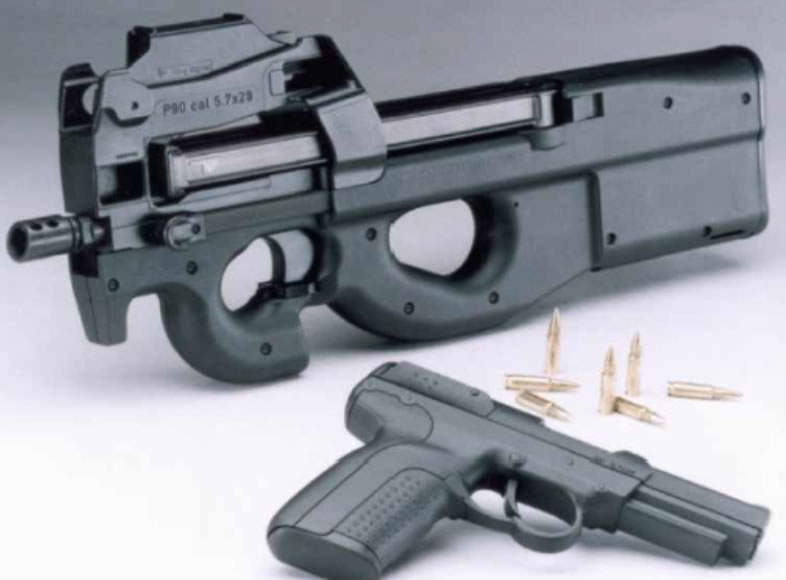
FN clearly understood that it was releasing a lethal genie. A spokesman for the company told the Sunday Times in 1996 that the pistol was “too potent” for normal police duties and was designed for anti-terrorist and hostage rescue operations.8 The NRA’s American Rifleman magazine claimed in 1999 that: “Law enforcement and military markets are the target groups of FN’s new FiveseveN pistol,” telling its readers, “Don’t expect to see this cartridge sold over the counter in the United States. In this incarnation, it is strictly a law enforcement or military round.”9 In 2000, American Handgunner magazine assured the public, “For reasons that will become obvious, neither the gun nor the ammunition will ever be sold to civilians or even to individual officers.”10
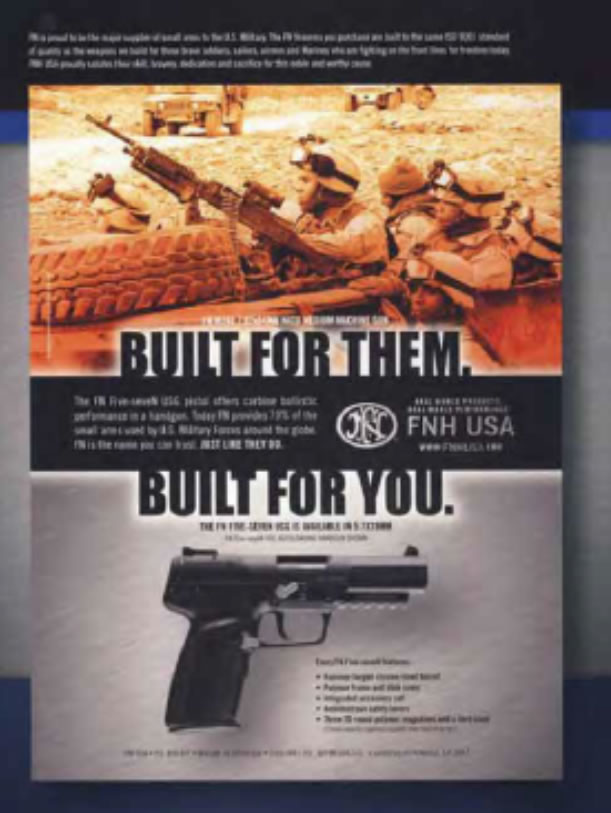
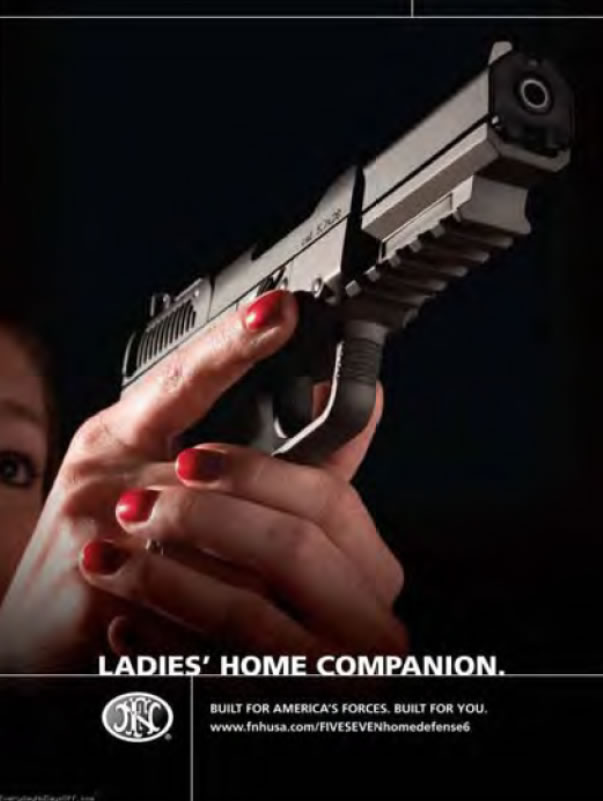
In fact, this handgun, described as being for anti-terrorist and hostage rescue operations with its law enforcement and military round were freely sold to civilians. FN was simply hyping its new product with widespread publicity in the gun press about “restricted” sales to military and police, and then—having whetted the gun buying public’s appetite—moved into the much bigger and more profitable civilian market. Eventually, the pistol, while still touting its military heritage (“Built for America’s Forces. Built for You.”) would be marketed to women as the “Ladies’ Home Companion.”
FN eventually voluntarily restricted the sale of armor-piercing rounds for the pistol to law enforcement and military buyers. In addition, the Five-seveN is one of the leading firearms illegally smuggled from the U.S. civilian gun market into Mexico, where it is known as the mata policia or “cop killer.”
ASSAULT RIFLES, ASSAULT PISTOLS, AND ASSAULT SHOTGUNS
Historically, semiautomatic assault weapons have been civilian versions of automatic or select-fire military assault rifles (like the AK-47 and M-16) and automatic military assault pistols (like the UZI). From these origins, the industry today markets a wide range of assault rifles, shotguns, and pistols, including pistol versions of semiautomatic AR- and AK-type assault rifles.
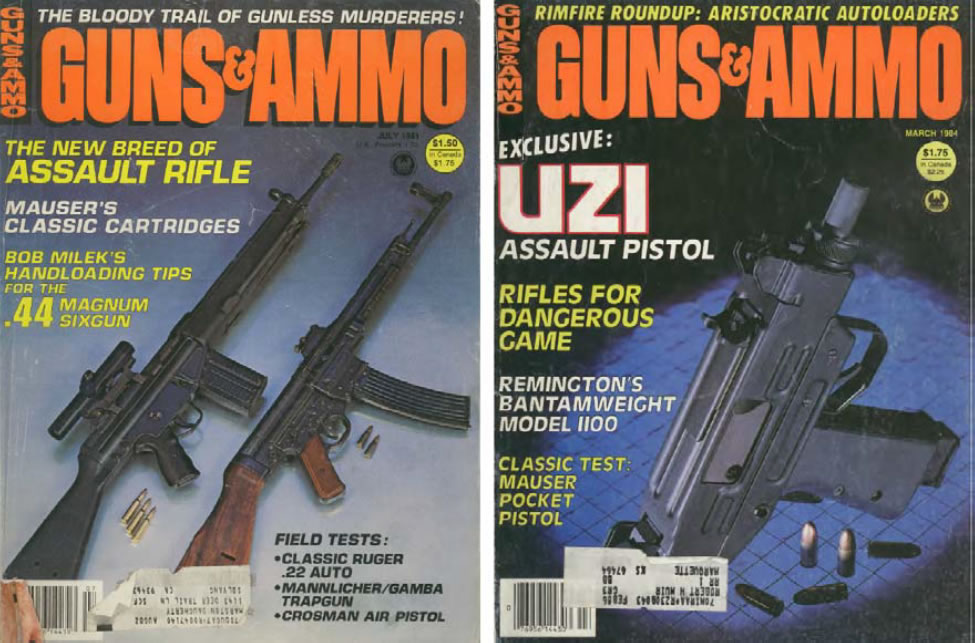
Although the gun lobby today argues that there is no such thing as civilian assault weapons, the industry, the National Rifle Association, and gun magazines enthusiastically described these civilian versions as “assault rifles,” “assault pistols,” and “military assault” weapons to boost civilian sales throughout the 1980s. Only after civilian assault weapons turned up in large numbers in the hands of drug traffickers, criminal gangs, mass murderers, and other dangerous criminals did the gun industry and its allies employ the false semantic that a “true” assault weapon can only be a machine gun and that the similarities were merely cosmetic. Yet the military forebears of civilian assault weapons “look” the same because functionally they are virtually identical, including the key anti-personnel element of being able to accept a large-capacity ammunition magazine that can be replaced in seconds once emptied. Military and civilian assault weapons differ only in one feature: military assault rifles are “machine guns.” A machine gun can fire continuously as long as its trigger is held back—until it runs out of ammunition. Many models also fire in shorter select-fire “bursts” (e.g., three rounds in a “burst”). Civilian assault rifles are semi-automatic weapons. In contrast, the trigger of a semiautomatic weapon must be pulled back separately for each round fired.
Because federal law bans the sale of new machine guns to civilians since 1986,11 and heavily regulates sales to civilians of pre-1986 machine guns, the civilian market for military assault weapons is extremely small and highly expensive. The gun industry introduced semiautomatic versions of these deadly military assault weapons in order to create and exploit civilian markets.
Assault Rifles
Today, virtually every major firearms manufacturer markets an assault rifle model. The bulk of these are primarily versions of the AR-15. These are supplemented by AK-47 models (both imported and domestically manufactured) as well as semiautomatic versions of non-AK or AR rifles.
The world’s armies developed assault weapons to meet specific combat needs. All assault weapons—military and civilian alike—incorporate specific features that were designed for laying down a high volume of fire over a wide killing zone. Civilian assault weapons feature the
specific military design features that make such “spray-firing” easy and distinguish assault weapons from traditional sporting firearms designed for hunting or target shooting.
The most important of these design features are—
- The ability to accept a large-capacity detachable ammunition magazine, some of which can hold as many as 75 or 100 rounds of ammunition.

- A rear pistol grip (handle), including so-called “thumbhole stocks.”
- A forward grip or barrel shroud. Forward grips (located under the barrel or the forward stock) give the shooter greater control over a weapon during firing and protect the shooter’s hand from the heat generated in the barrel due to the high number of rounds fired.

The gun lobby and firearms industry have, for decades, attempted to convince the general public that civilian assault rifles are mere sporting guns. As part of this effort, the National Shooting Sports Foundation has attempted to rebrand assault rifles as “Modern Sporting Rifles,” to the point of declaring the AR-15 “America’s Rifle” (with no acknowledgment of the irony contained in the characterization, recognizing the use of AR-15s in numerous mass shootings).12 Yet, in his 1986 book Assault Pistols, Rifles and Submachine Guns pro-gun author and assault weapon expert Duncan Long dismissed the suggestion that semiautomatic civilian assault rifles were different in any substantial way from their full-auto military counterparts, writing:
The next problem arises if you make a semiauto-only model of one of these selective-fire rifles. According to the purists, an assault rifle has to be selective fire. Yet, if you think about it, it’s a little hard to accept the idea that firearms with extended magazines, pistol grip stock, etc., cease to be assault rifles by changing a bit of metal.
Yet, industry members recognize that it is precisely the military pedigree and firepower that make these guns so appealing to a segment of the gun-buying public. As a result, some within the gun industry’s own ranks, despite admonitions from the NSSF and the NRA, continue to call semiautomatic assault rifles what they are—assault rifles—and even write lurid prose promoting the worst features of these guns.
For example, the August 2010 edition of Gun World magazine heralded “Ruger’s Mini-14 Tactical Rifle” as “‘Combat Customized’ From the Factory.” Among other outbursts of naked candor in the enthusiastic article were the following—
- “Ruger’s Mini-14 Tactical Rifle is a version of the well-established Mini-14 incorporating many of the assault rifle features that end users have being [sic] applying themselves for decades, this time straight from the factory.”
- “Being seen over the years as a sort of ‘poor man’s assault rifle’ the Mini-14 has spawned a huge array of after-market parts that may be applied to make it more ‘assault rifle-y.’ Recently Sturm, Ruger & Co. finally decided to get into the act themselves by producing their Mini-14 Tactical Rifles.”
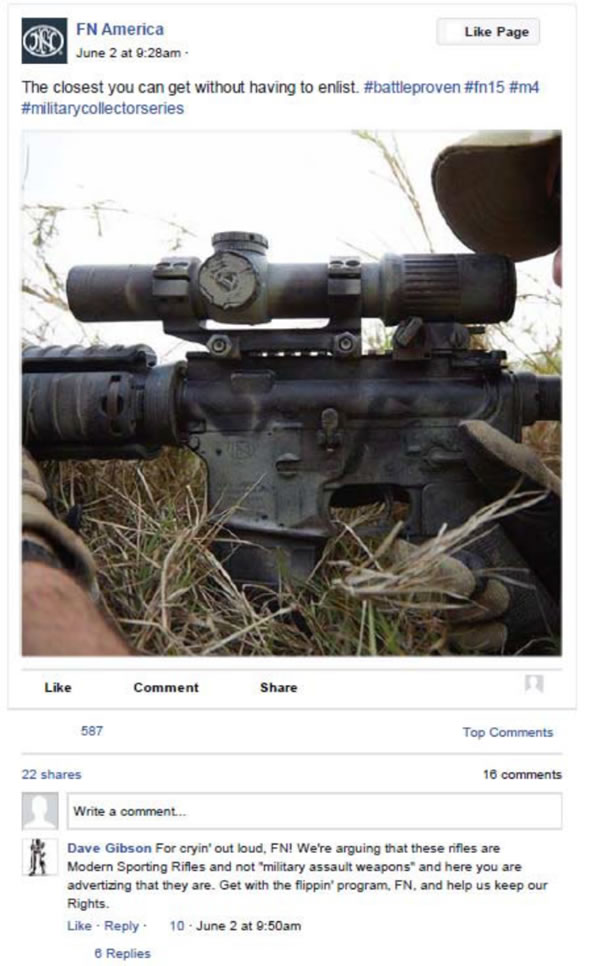
In June 2016 on its Facebook page, assault weapon manufacturer FN America posted a picture of one of its assault rifles with the heading, “The closest you can get without having to enlist.” It was followed by the hash tags #battleproven, #fn15, #m4, and #militarycollectorseries. In reaction to the post, one commenter wrote, “For cryin’ out loud, FN! We’re arguing that these rifles are Modern Sporting Rifles and not ‘military assault weapons’ and here you are
advertizing [sic] that they are. Get with the flippin’ program, FN, and help us keep our Rights.”
Assault Pistols
Assault pistols are semiautomatic handguns that are either originally designed for military application or utilize design features that facilitate continued firing for anti-personnel use. Design elements that are common among assault pistols are: the ability to accept a large-capacity detachable ammunition magazine; a magazine well that is outside of the pistol grip (facilitating two-handed firing); and, a barrel shroud to protect the shooter’s hand from a heated barrel resulting from continued firing.
During the 1980s and 1990s, UZI pistols, MAC-10s, and TEC-9s were the prominent assault pistols seen on television and movie screens as well as displayed on gun store counters. Today, more assault pistol makes and models are available than ever before for civilian sale in the United States. UZIs, MACs, and TECs, have been joined by a wide range of new models.13
This increase in the quantity of makes and models has been matched by a marked increase in their lethality. Whereas the earlier generation of assault pistols were primarily high-capacity military-style pistols in 9mm or 45 caliber, the most popular models today are derived from military style assault rifles, such as the AR-15 and AK-47. As a result, they have the penetrating power of an assault rifle in the concealable format of a pistol. Whereas the most commonly worn levels of police body armor would be able to protect the wearer from a 9mm or 45 caliber handgun round, a .223 or 7.62 rifle round would be far more likely to penetrate.
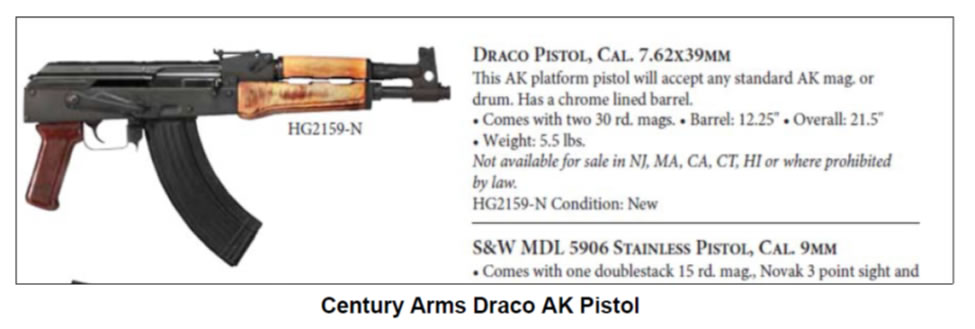
As one poster on www.SurvivalistBoards.com wrote about the Draco AK-47 pistol, “It can penetrate body armor and holds 30+ rounds….I figure this is a lot of firepower in a legal and small package.”14 Or, as a 2011 article published in Handguns magazine titled “AR Pistols: The Hugely Popular Rifle Platform Makes a Pretty Cool Handgun as Well” noted, “There’s no doubt in the last few years that AR pistols have become extremely popular.”15
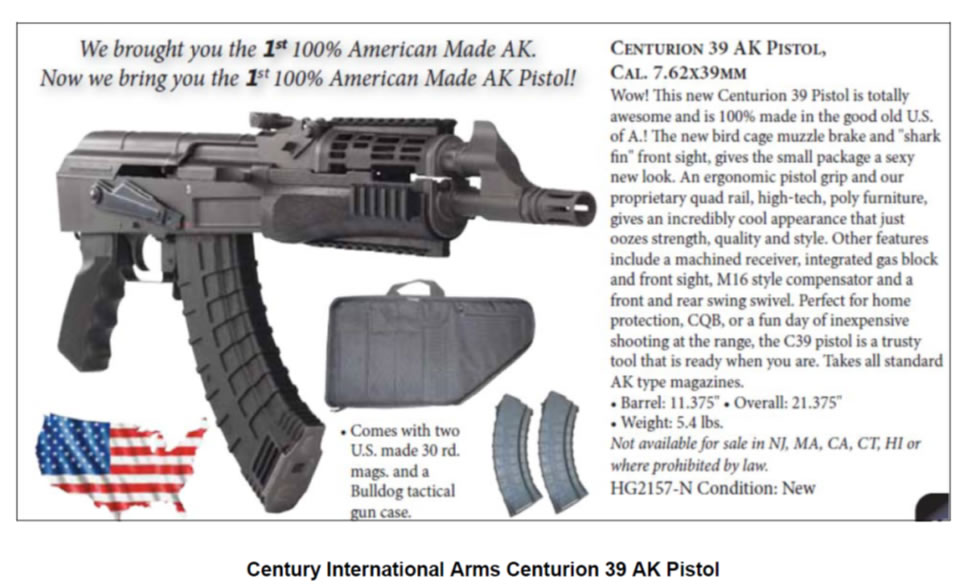
In a segment on his cable television show Ted Nugent’s Spirit of the Wild titled “Uncle Ted’s Favorite Guns,” former National Rifle Association board member Ted Nugent16 cheerfully acknowledged the military pedigree and lauded the rifle power of the Century International Arms Centurion 39 AK-47 pistol. Said Nugent, “This is a variation of what they lovingly refer to as the Kalashnikov, the AK-47….This is a handgun version, almost what you see the bad guys in Afghanistan use…7.62 x 39mm, out of a little, short, rifle basically, but it’s a handgun, this is a handgun. It’s legal, without a Class III ATF forms.”17
Assault Shotguns
Assault shotguns are a more recently popular entrant in the arsenal of assault weapons available on the civilian market. This category of firearm includes semiautomatic shotguns that incorporate assault weapon characteristics such as pistol grips and/or large capacity detachable ammunition magazines. Many are designed to skirt the minimum length requirements of the National Firearms Act (NFA). There are also pump action shotguns that incorporate pistol grips, and/or utilize detachable large capacity ammunition magazines. Bullpup design shotguns are also an expanding category.
AK- and AR-type Assault Shotguns
In 2011, ATF attempted to prevent the importation of some assault shotgunsꟷsuch as the Saiga made in Russia by Izhmash ─ as lacking a sporting purpose.18 In response, later that year Congress attached a rider to ATF’s appropriations to prevent the agency from denying importation to any shotgun that had previously been imported. In 2014, importation of Kalashnikov Saiga shotguns was banned as part of the Ukraine-related sanctions imposed on Russia.19 Kalashnikov responded by manufacturing AK-type shotguns in the United Statesꟷand U.S. manufacturers soon followed their lead, introducing their own models.
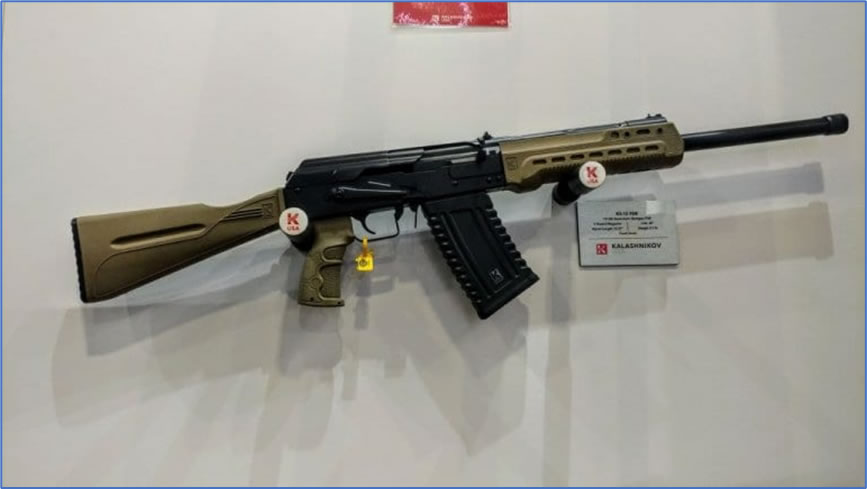 Kalashnikov USA 12 Gauge Semiauto Shotgun
The U.S.-made Kalashnikov USA shotgun was described by one gun reviewer in 2021 as “an AK shotgun for all you psychos out there.” The reviewer observed, “The Saiga 12 magazine-fed shotguns forced manufacturers to up the ante, and now everyone is trying to fill the market with AK-modeled shotguns.”20 The Kalashnikov is one of 10 magazine-fed shotguns included in the review. According to one gun blogger, “The absence of Saiga magazine fed shotguns has left a gap a ton of manufacturers are vying to fill with AK shotguns. The [Kalashnikov USA] KS12 seems to be the first potential true replacement for the Saiga 12.”21
Additional examples of additional U.S.-manufactured AK-type assault shotguns are offered below.
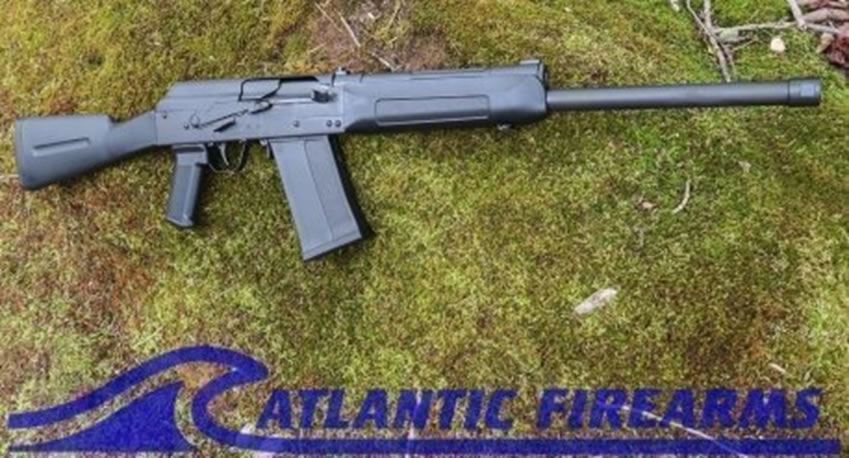 Lynx 12 AK Shotgun
At the same time, assault shotguns patterned on AR-type assault rifles are also marketed, as seen from the ads below.
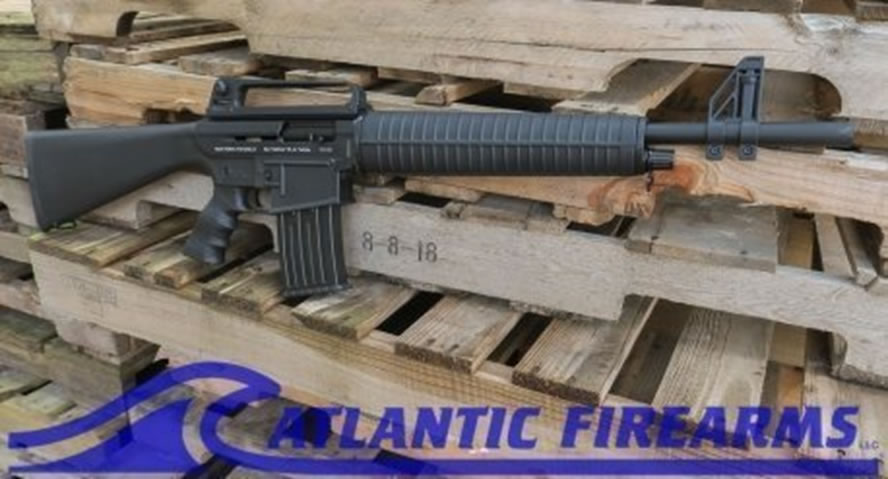 FR-99 Semi Auto Shotgun22
 Armelegant 12 Gauge Tactical Shotgun23
Weapons that Evade NFA Regulation as Short-Barreled Shotguns
Another category of assault shotgun includes those specifically designed to evade regulation as a “short barreled shotgun” under the National Firearms Act (NFA). The NFA requires that shotguns with an overall length of less than 26 inches or a barrel of less than 18 inches be registered with the federal government. The purchase of short-barreled shotguns also requires a background check (including a photograph and fingerprints), notification of local law enforcement, and payment of a transfer tax. Short-barreled shotguns are subject to additional regulation because they are more concealable than standard-size shotguns.
Manufacturers such as Remington are designing shotguns to evade the requirements of the NFA. Remington’s TAC‐14 (see below) is not categorized as a shotgun because it is not designed to be fired from the shoulder. Rather, it incorporates a pistol grip in lieu of a buttstock.
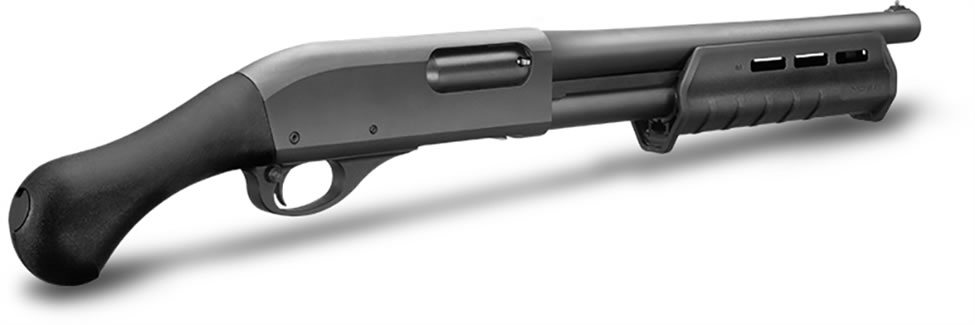 Remington TAC-14 Shotgun
Another tactic that has been used by manufacturers to avoid the NFA is to attach a “stabilizing brace” to a shotgun configured as a pistol. One example of this is the Fostech Origin 12 Short Barrel Shotgun which the manufacturer describes as “the fastest semi-auto shotgun on the planet.”24
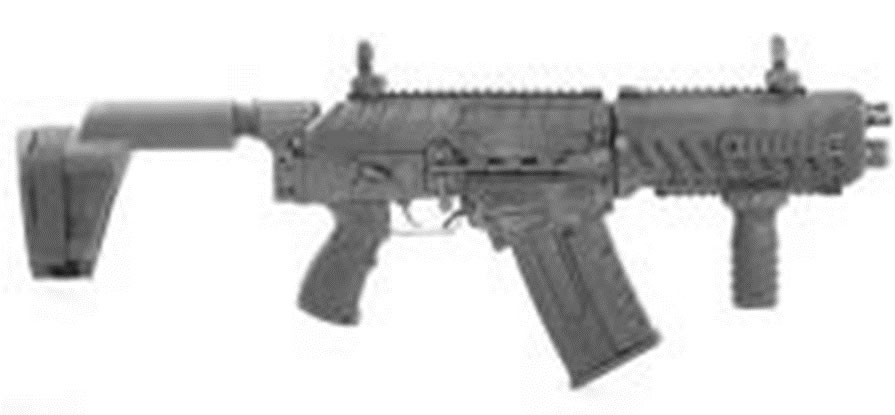 FOSTECH Origin 12 Short Barrel Shotgun with side folding brace
However, in a June 25, 2019 letter, the Bureau of Alcohol, Tobacco, Firearms and Explosives changed its method for measuring the overall length of AR- and AK-style pistols. The letter stated:
[I]t is inappropriate to include a folding ‘stabilizing brace’ accessory in the overall length measurement of a firearm because, unlike a rifle or shotgun, a stabilizing brace is not an element of either a statutory or regulatory definition of a firearm…The measurement of a folding or collapsible stabilizing brace in the overall length of a firearm creates an artificial overall length that would permit a maker to avoid classification as an NFA ‘firearm’ without a viable design purpose or legal justification.25
High-Capacity Pump-Action Shotguns
While pump-action shotguns have long existed, this category of shotgun, originally designed for sporting use, has also been transformed through militarization.
High-capacity pump action shotguns include both guns that can accept detachable large-capacity ammunition magazines (such as the Mossberg 590M that can use 20-round double-stack magazines)26 to weapons that use a tube reloading system (such as the KEL-TEC KSG-25).
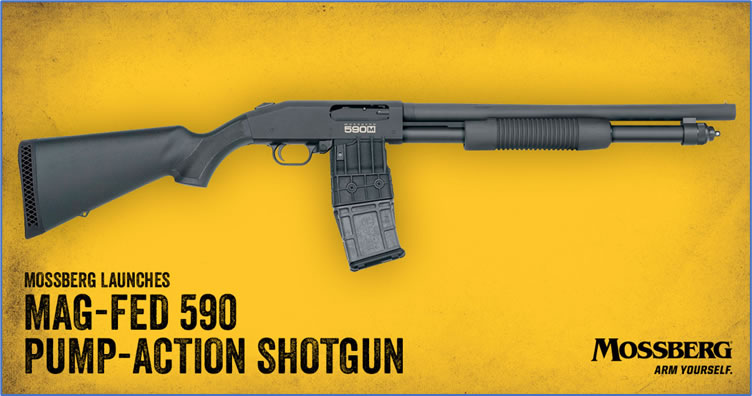 Mossberg 590M pump-action shotgun with detachable ammunition magazine
Bullpup Shotguns
The term Bullpup describes a gun with the ammunition magazine and the action located behind the trigger. As a result, bullpup shotguns have a shorter overall length than a conventional design assault rifle and can offer increased capacity. Bullpup shotgun designs are increasingly common and come in both semiautomatic and pump-action models. Examples of semiautomatic and pump action bullpup shotguns are offered below.
Semiautomatic Bullpup Assault Shotguns
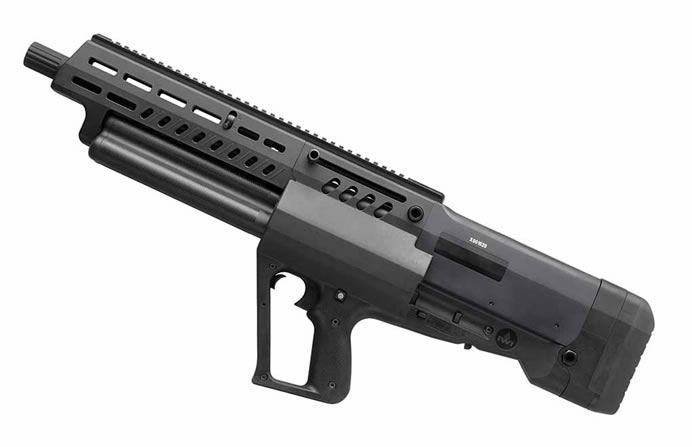 IWI Tavor TS12
In a December 2020 online review from the National Rifle Association’s ShootingIllustrated.com, the author gushed:
The world is witnessing a golden age of tactical shotguns right now, and IWI’s Tavor TS12 represents the cutting edge of new-shotgun design in a market dominated since 1887 by single-magazine-tube guns. Some such designs are even gaining favor. Why?
High-capacity, bullpup-style shotguns offer some obvious advantages over traditional models, including a shorter overall length for greater maneuverability and the ability to put more rounds downrange before reloading. IWI’s TS12 offers these traits in spades, and it also has something else civilian consumers want: Badass looks.27
In a section of the article titled “Final Thoughts,” the author adds:
Its ability to fire 16 shells without reloading is impressive, and the 12 gauge’s close-quarters power is unquestioned. This, combined with the fact that it’s less than 30 inches long overall makes it an attractive option for security forces who need maximum firepower carried discreetly, or for units that need a man armed with a shotgun for door breaching. For home defenders, it’s a powerful tool, indeed, as it’s short enough that it can be easily wielded around corners or slung and carried on the back if the hands are needed for other purposes.28
Additional examples of semiautomatic bullpup shotguns from Fedarm and TriStar Arms are follow.
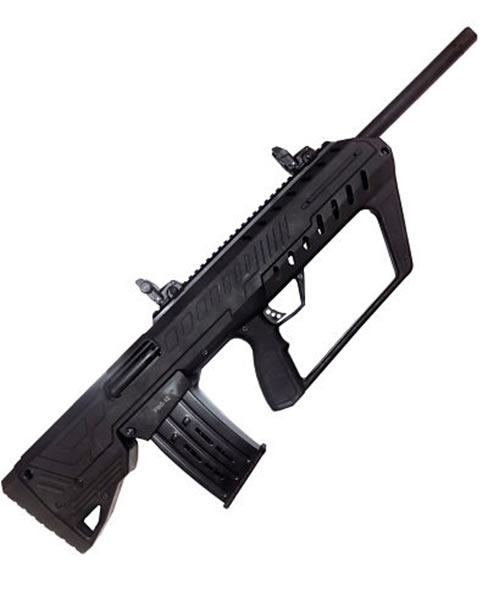 Fedarm FBS 1229
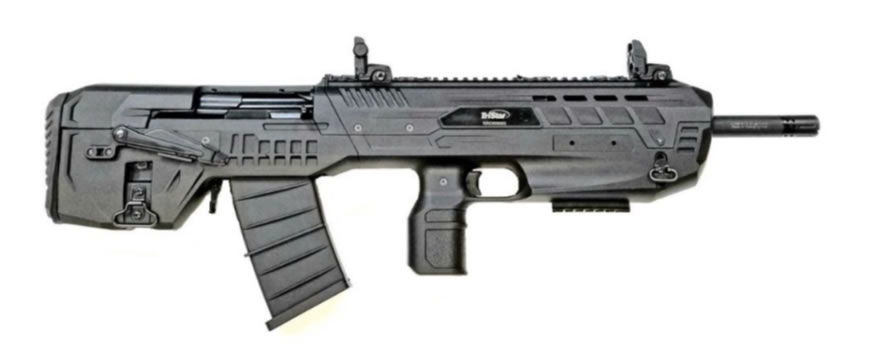 TriStar Compact Tactical30
Pump-Action Bullpup Assault Shotguns
The mainstreaming of bullpup assault shotguns is evidenced by the recent introduction of the Smith & Wesson M&P (Military & Police) 12. The high-capacity S&W bullpup shotgun has dual magazine tubes that each hold six or seven rounds depending on the type of shells used for a maximum capacity of 15 rounds. In August 2021, gun publication Tactical Life described the new shotgun as, “Utilizing a compact, pump-action design, the Smith & Wesson M&P12 Bullpup Shotgun brings devastating firepower in a defensive package.”31 In promoting the gun on its website, Smith & Wesson states, “Designed for home protection, the M&P12 shotgun is packed with features in a compact, maneuverable package.”32
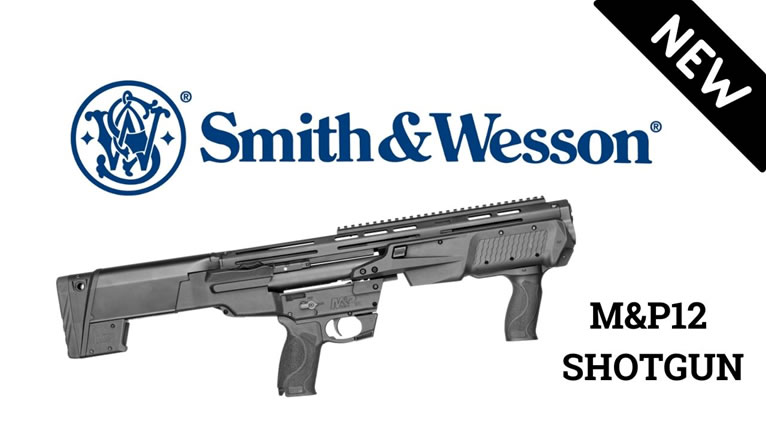 Smith & Wesson M&P (Military & Police) 12
The Smith & Wesson shotgun takes its inspiration from the Kel-Tec KSG, a similar bullpup design with an equal capacity.
As an Ammoland review of the KSG-25 stated, “Despite its appearance, the KSG-25 is neither semi-automatic nor capable of firing plasma bursts. Instead, Kel-Tec took the venerable pump-action, tube-fed shotgun and rearranged the internals to better fit the average shooter. But unlike the overwhelming majority of pump-action shotguns in existence, the KSG series of shotguns utilize two parallel magazine tubes to increase capacity without needlessly increasing the overall length of the gun.”33
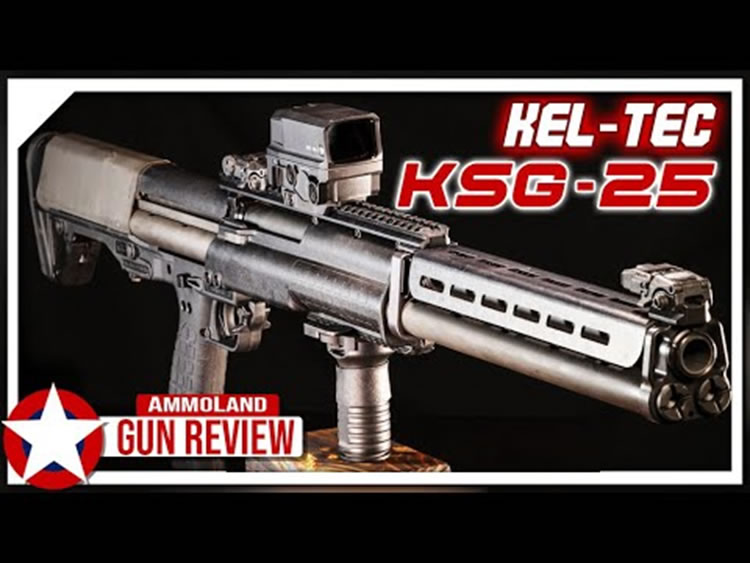 Kel-Tec KSG-25
After noting that “it would be a nightmare to load this firearm under stress in low-light conditions without hours of practice,” the review reassures the reader, “The good news is that with a capacity of 25 rounds, you won’t need to reload under stress. Since no threat on planet Earth short of a Japanese BANZAI charge or velociraptor ambush would require more than 25-rounds of 00 buck to stop. Wink, wink.”34
Compared to assault pistols and assault rifles, assault shotguns are a relatively new entrant in the vast market of assault weapons currently available to the general public. Unlike other military-bred weapons, little effort is made to try and conjure a sporting purpose for these guns. Instead, the focus is frequently on their capacity, lethality, and “badass” looks. As an email promo for the review of Kel-Tec’s KSG-25 ─ summarized, “because America!” [Emphasis in original]35
50 Caliber Anti-Armor Sniper Rifles
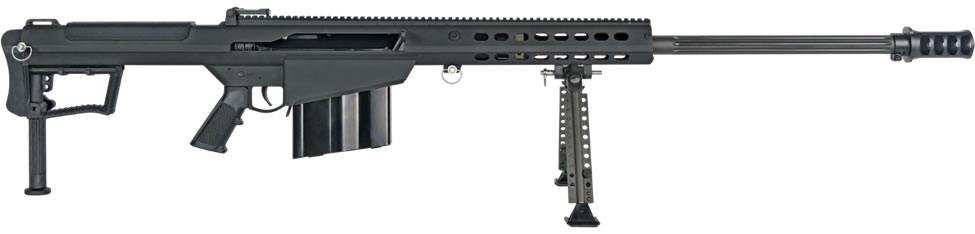 Barrett M 107A1 50 Caliber Semiautomatic Rifle
The 50 caliber anti-armor sniper rifle is a case of militarization in which precisely the same weapon is sold on the civilian market as that sold to the world’s armed services.36
Fifty caliber is the largest round of ammunition generally available to American civilians today, measuring half an inch wide. Fifty caliber anti-armor sniper rifles are specifically designed to engage and destroy materiel targets on the battlefield at long range. These anti-armor rifles, measuring almost five feet long, feature a range and striking power that is far beyond that of any hunting rifle, and beyond that of the rifles our infantry carry. Armored personnel carriers, aircraft, rail tank cars, bulk fuel storage, and concrete bunkers are vulnerable to 50 caliber rifle fire at distances of 1,000 to 2,000 yards. Our soft civilian infrastructure—airports and the jetliners in them, rail cars carrying hazardous materials, and toxic chemical bulk storage plants —is even more open to attack by these rifles than its military counterpart.
This lucrative weapon was invented in the early 1980s by a Tennessee commercial photographer, Ronnie G. Barrett, who derived the sniper rifle from the Browning 50 caliber machine gun. Barrett’s 1987 patent called his new invention an “anti-armor gun.” He described the rifle in his patent claim as a “shoulder-fireable, armor-penetrating gun,” explaining:
The recoil and weight of the Browning M-2 heavy-barrel machine gun (50 cal.), belt-fed, make it unsuitable for firing from the shoulder. The bolt-fed sniper rifle of smaller weight and caliber will not penetrate armored targets. The bolts of guns of a caliber that will penetrate armored targets are often broken by recoil because of excessive strain on the lock lugs. Thus, there is a need for a light-weight, shoulder-fireable, armor-penetrating gun that can stand up to heavy duty use. After extended investigation I have come up with just such a gun.
Barrett Firearms Manufacturing, Inc. is today the leading supplier of 50 caliber anti-armor sniper rifles to U.S. military forces and many other armies of the world. The weapons can penetrate armor plating, down aircraft on take-off and landing, and are accurate up to a mile away.
Barrett has also aggressively marketed its anti-armor rifles to civilian buyers in the United States. After Barrett effectively created a new civilian market for his anti-armor rifles, competition sprung up, including such manufacturers as Armalite, Serbu, Accuracy International, and others. Other manufacturers offer belt-fed, tripod-mounted semiautomatic 50 caliber weapons. Fifty-caliber sniper rifles are a favored weapon of cross-border gun traffickers from the U.S. to Mexico where they have been used in numerous high-profile attacks on Mexican law enforcement as well as intra-cartel battles.
In spite of their battlefield pedigree, 50 caliber anti-armor rifles are no more regulated under federal law than a 22 caliber target rifle, and are less regulated than handguns. Under federal law, anyone at least 18 years of age who is not in a category as to whom transfers or possession of firearms is prohibited—such as convicted felons—can legally buy any .50BMG anti-armor sniper rifle sold in America. But it is against the law for a federally licensed dealer to sell a handgun to anyone less than 21 years of age.
Future Military Advances for Possible Civilian Sale
The gun industry is not static. Whether for military use, civilian use, or military weaponry that can be adapted for civilian sale, it is always working to increase the lethality of its products in the hope of increased sales. To focus solely on the industry’s current product line is to ignore potential public safety threats in the future. Two examples follow.
Volley Guns
A volley gun has several barrels for firing a number of shots, either simultaneously or in succession, with one pull of the trigger.
The manufacturer of the Thunderstruck revolver markets its gun as having “Fast and Tremendous Firepower” and describes how “each pull of the trigger fires 2 rounds simultaneously and 4 pulls of the trigger delivers 8 rounds.”
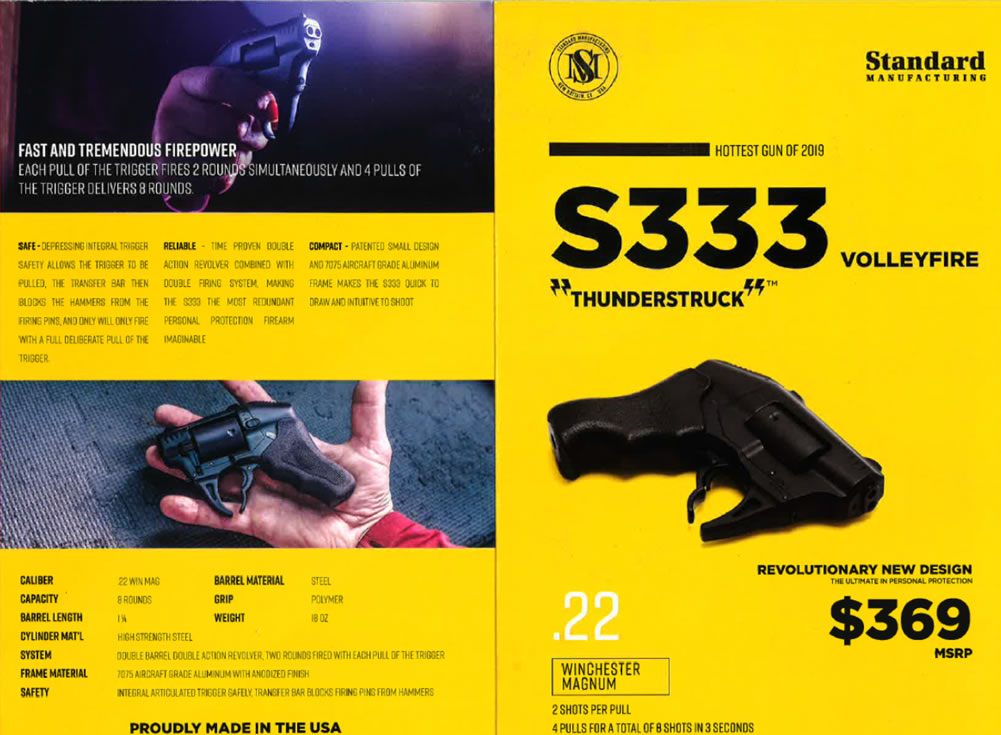
There are currently few volley guns on the market today and those available are limited to small, concealable handguns. However, manufacturers are working to develop much more powerful firearms that operate as volley guns. Forward Defense Munitions, Co. (FDM) claims to be developing a rifle that can fire up to five rounds at a time simultaneouslyꟷnot in quick succession. According to the company’s website, “With a unique action, barrel and ammunition, FDM’s ‘L5’ proof-of-concept prototype is the first rifle in an entirely new firearm class. The L5 supersedes AR, AK, and similar platforms that have lingered for decades.”37 FDM originally presented the L5 as a weapon designed for military use. But according to an article on the website guns.com, “[I]t’s not just the military that could see the gun. According to the company’s website, they expect production on the civilian L4 model to begin in the middle of 2019, noting that, ‘Pricing is TBD.’”38 As of June 2022, the production date has been dropped, but visitors to the website can sign up for an update list, “Due to substantial interest in the L4….”39
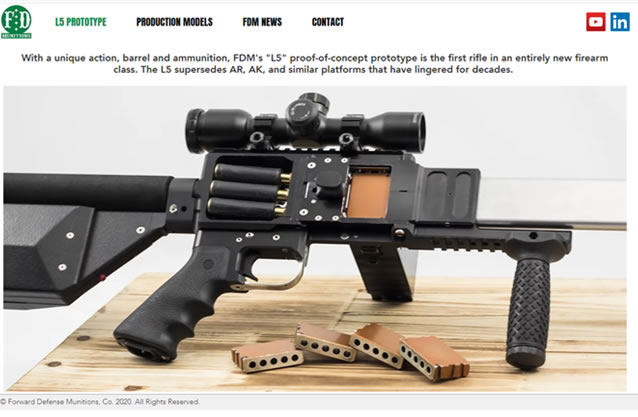 FDM’s website features a prototype model of its L5 volley gun rifle
ATF has taken the position that volley guns are not subject to NFA registration, stating, “A trigger pull resulting in one shot occurring from multiple barrels would be legal.”40 This is despite the fact that according to the agency: “The term “machinegun” means any weapon which shoots, is designed to shoot, or can be readily restored to shoot, automatically more than one shot, without manual reloading, by a single function of the trigger.”41 [emphasis added].
Emergent Cartridge Technology
FDM’s L5 uses what is known as caseless ammunition. Standard ammunition consists of the casing, primer, powder, and bullet. Caseless ammunition, however, lacks a metal shell casing. Instead, caseless ammo consists of a projectile, a solid propellant that functions as the cartridge body, and a primer. The introduction of this new class of cartridge technology on the civilian market could have profound impacts on the level of firepower available to mass shooters, criminal organizations, and terrorists. The advantages of weight and volume reduction offered by caseless ammunition would likely produce an increase in overall hit probability as the number of rounds that could be carried in a firearm increases. Caseless ammunition could also result in an overall increase in a weapon’s rate of fire as the need to extract and eject a fired cartridge is eliminated. Such technologies could reduce reloading and jamming which could have significant negative impacts in a mass shooting scenario where shooters are often stopped when they reload or their guns jam. Such technology could also increase the risk to officer safety. In addition, the lack of a casing would also hinder law enforcement investigations, recognizing that both casings and bullets are used by law enforcement in their investigatory work.
- See, for example, Jane’s Infantry Weapons 1983-1984 (London: Jane’s Publishing Company Limited), “.45 Model 1911A1 automatic pistol,” p. 66.
- “Backgrounder on Glock 19 Pistol and Ammunition Magazines Used in Attack on Representative Gabrielle Giffords and Others,” Violence Policy Center, January 2011, https://www.vpc.org/fact_sht/AZbackgrounder.pdf.
- “Italian Gun Maker Beretta Hits U.S. Market with a Bang,” The Plain Dealer, August 18, 1993 (reprint of Baltimore Sun article).
- The Militarization of the U.S. Civilian Firearms Market, Violence Policy Center, June 2011,
https://vpc.org/studies/militarization.pdf. - For more information, see the July 2000 Violence Policy Center study Pocket Rockets: The Gun Industry’s Sale of Increased Killing Power, https://vpc.org/wp-content/uploads/2020/03/Pocket-Rockets-2000.pdf.
- Jane’s Infantry Weapons 1983-1984 (London: Jane’s Publishing Company Limited), “Revolvers and Self-loading Pistols,” p. 9.
- See https://www.smith-wesson.com/ourstory.
- “SAS gets handgun that can shoot through walls,” Sunday Times, July 7, 1996.
- “Military Small Arms Update: FN’s FiveseveN System,” American Rifleman, November/December 1999.
- “FN Five-seveN,” American Handgunner, January/February 2000.
- See, 18 U.S. Code, § 922(o).
- For a selection of mass shootings (three victims or more as defined by federal law) involved semiautomatic weapons equipped with large-capacity ammunition magazines, including AR-15-type assault rifles, see Mass Shootings in the United States Involving Large Capacity Ammunition Magazines, Violence Policy Center, May 2022, https://vpc.org/fact_sht/VPCshootinglist.pdf.
- See, for example, Assault Pistols: The Next Wave, Violence Policy Center, January 2013, https://vpc.org/studies/awpistols.pdf.
- Assault Pistols: The Next Wave, Violence Policy Center, January 2013, https://vpc.org/studies/awpistols.pdf.
- “AR pistols: the hugely popular rifle platform makes a pretty cool handgun as well,” Handguns, June/July, 2011.
- In July 2021, Nugent resigned from the NRA’s board amidst the organization’s ongoing financial and legal troubles. In a statement ending his 26-year tenure, Nugent stated, “I was not voted onto the board as an accountant, administrator, paper shuffler or bureaucrat, but rather to lead the charge of the good guys against the bad guys in this vile culture war that has reached a deafening roar…So due to constant scheduling conflicts, I hereby resign my position on the NRA Board of Directors, wishing you well and Godspeed.” See “Ted Nugent Explains Decision To Resign From NRA Board,” Blabbermouth.net, August 3, 2021,
https://www.blabbermouth.net/news/ted-nugent-explains-decision-to-resign-from-nra-board/. - See http://www.youtube.com/watch?v=B9DdiGu6ZYI, YouTube upload date March 2, 2011. Under the National Firearms Act (NFA)—the federal law regulating machine guns, short-barreled rifles, and other “gangster” weapons—a Class III weapons license with heightened transfer standards would need to be obtained from the federal Bureau of Alcohol, Tobacco, Firearms and Explosives (ATF) for the civilian purchase of a short-barreled rifle.
- Study on the Importability of Certain Shotguns, Bureau of Alcohol, Tobacco, Firearms and Explosives, Firearms and Explosives Industry Division, January 2011.
- Consolidated and Further Continuing Appropriations Act, 2012, Public Law 112-55, Section 541 (enacted November 18, 2011, and continued for fiscal year 2013 in Public Law 112-175).
- “Best Magazine-Fed Shotguns [2022],” Gun Made, downloaded April 11, 2022, https://www.gunmade.com/best-magazine-fed-shotguns/.
- “The Top 5 Magazine Fed Shotguns,” The Maglife Blog, June 15, 2020, https://gunmagwarehouse.com/blog/the-top-5-magazine-fed-shotguns/.
- See https://atlanticfirearms.com/fr-99-semi-auto-shotgun.
- See https://atlanticfirearms.com/armelegant-12-gauge-tactical-shotgun-ang-10.
- See https://fostech.com/product/origin-12-short-barrel-shotgun/.
- Michael R. Curtis, Chief, Firearms Technology Industry Services Branch letter to redacted recipient, June 25, 2019.
- See, for example, https://gunmagwarehouse.com/mossberg-590m-12-gauge-20-round-magazine.html.
- “Review: IWI Tavor TS12 Shotgun,” ShootingIllustrated.com, December 7, 2020, https://www.shootingillustrated.com/content/review-iwi-tavor-ts12-shotgun/.
- “Review: IWI Tavor TS12 Shotgun,” ShootingIllustrated.com, December 7, 2020, https://www.shootingillustrated.com/content/review-iwi-tavor-ts12-shotgun/.
- See https://fedarm.com/product/fbs-semi-auto-bullpup-shotgun-12-gauge/.
- See https://www.tristararms.com/series/compact-tactical/#compact-tactical-black.
- “S&W M&P12 Bullpup Shotgun Brings Compact Firepower for Defense,” Tactical Life, August 17, 2021, https://www.tactical-life.com/firearms/shotguns/sw-mp12-bullpup-shotgun/.
- See https://www.smith-wesson.com/product/mp-12.
- “Kel-Tec KSG-25 – Because Screw Reloading!,” Ammoland, March 10, 2022, https://www.ammoland.com/2022/03/kel-tec-ksg-25-because-screw-reloading-video/#axzz7QB7e1a2k.
- “Kel-Tec KSG-25 – Because Screw Reloading!,” Ammoland, March 10, 2022, https://www.ammoland.com/2022/03/kel-tec-ksg-25-because-screw-reloading-video/#axzz7QB7e1a2k.
- Email in files of Violence Policy Center.
- For a wide range of Violence Policy Center studies on the threat posed by 50 caliber anti-armor sniper rifles, see https://vpc.org/regulating-the-gun-industry/50-caliber-anti-armor-sniper-rifles/.
- See https://www.fdmunitions.com/copy-of-l5-prototype. For an FDM promotional video for the L5 see https://youtu.be/aMLXXMVeQak.
- “The FDM ‘Ribbon Gun’ Could Bring Caseless Ammo by the Salvo to the Army,” guns.com, October 2, 2018,
https://www.guns.com/news/2018/10/02/the-fdm-ribbon-gun-could-bring-caseless-ammo-by-the-salvo-to-the-army-videos. - See https://www.fdmunitions.com/productionmodels.
- Earl Griffith, Chief, Firearms Technology Branch, Letter, Recipient Redacted, Bureau of Alcohol, Tobacco, Firearms and Explosives, December 27, 2013.
- 26 USC § 5845 (b).