For Release: Tuesday, September 9, 2025
Highest Rates in States with Higher Gun Ownership Rates, Weaker Gun Violence Prevention Laws
New VPC Analysis Released for National Suicide Prevention Week During National Suicide Prevention Awareness Month in September
Washington, DC — States with lower rates of gun ownership and stronger gun violence prevention laws have the lowest overall suicide rates in the nation according to a new Violence Policy Center (VPC) analysis of 2023 data (the most recent and complete year available) from the Centers for Disease Control and Prevention’s National Center for Health Statistics. Conversely, states with the highest suicide rates have higher gun ownership rates and weaker gun violence prevention laws.
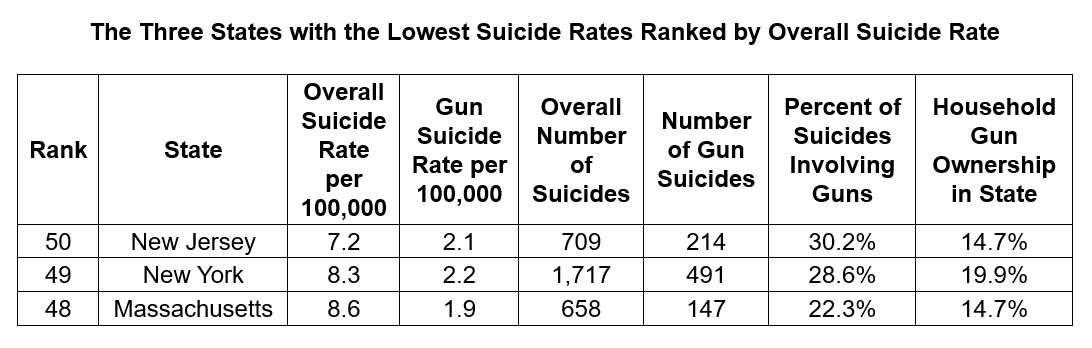
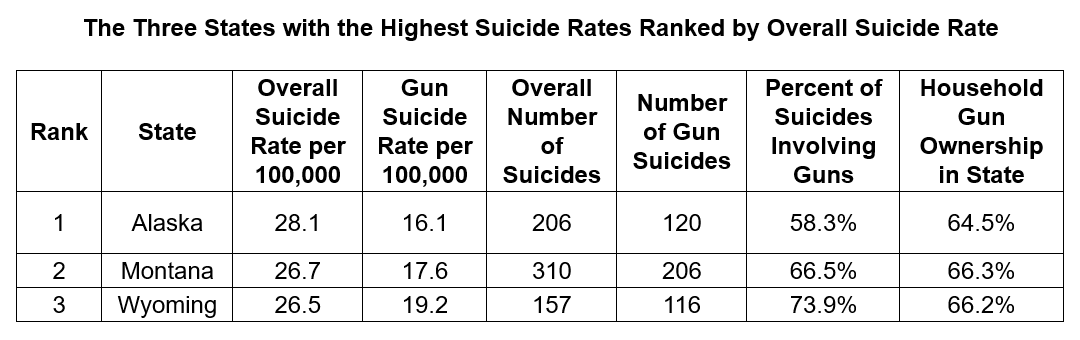
The tables below list the states with the three lowest and three highest overall suicide rates in 2023 and include for each state its overall suicide rate, gun suicide rate, total number of suicides and gun suicides, percentage of suicides that involved a gun, and average household gun ownership rate. A similar table for all 50 states ranked by overall suicide rate is available here.
The state with the lowest overall suicide rate in 2023 was New Jersey (7.2 suicides per 100,000 residents) with a gun suicide rate of 2.1 gun suicides per 100,000 residents. New York ranked second lowest (overall suicide rate of 8.3 suicides per 100,000 residents) with a gun suicide rate of 2.2 gun suicides per 100,000 residents. Massachusetts ranked third lowest (overall suicide rate of 8.6 suicides per 100,000 residents) with a gun suicide rate of 1.9 gun suicides per 100,000 residents. In each of these three states guns were used in less than 31 percent of the suicides reported that year and all had a household gun ownership rate below 20 percent. Compared to the three states with the highest suicide rates, each of these states has stronger gun violence prevention laws.
The state with the highest overall suicide rate in the nation in 2023 was Alaska (28.1 suicides per 100,000 residents), with a gun suicide rate of 16.1 gun suicides per 100,000 residents. Montana ranked second (26.7 suicides per 100,000 residents) with a gun suicide rate of 17.6 gun suicides per 100,000 residents. Wyoming ranked third (26.5 suicides per 100,000 residents) with a gun suicide rate of 19.2 gun suicides per 100,000 residents. In each of these three states guns were used in 58 percent or more of the suicides reported that year and all had a household gun ownership rate above 64 percent. Compared to the states with the lowest suicide rates, each of these states has weak gun violence prevention laws.
In 2023 there were 49,316 suicides in the United States. Of these, the majority (27,300 or 55.4 percent) were firearm suicides. In 2022 there were 49,476 suicides in the United States, of these 27,032 (54.6 percent) were firearm suicides. Compared to 2022, the overall suicide rate decreased slightly from 14.3 to 14.1 per 100,000. The gun suicide rate stayed the same between 2022 and 2023 at 7.6 per 100,000.
VPC Executive Director Josh Sugarmann states, “Guns are the most common suicide means in our nation. Recognizing this, it’s unfortunately not surprising that year after year states with lax gun laws and higher rates of firearms ownership have the highest suicide rates. At the same time, states with tougher gun laws and lower gun ownership rates consistently have the lowest rates of suicide. Reducing access to firearms is a critical element in helping prevent suicide.”
The VPC defines states with “weaker” gun violence prevention laws as those that add little or nothing to federal law and have permissive laws governing the open or concealed carrying of firearms in public. States with “stronger” gun violence prevention laws were defined as those that add significant state regulation that is absent from federal law, such as restricting access to particularly hazardous and deadly types of firearms (for example, assault weapons), setting minimum safety standards for firearms and/or requiring a permit to purchase a firearm, and restricting the open and concealed carrying of firearms in public.
The age-adjusted rates published in this report were calculated by the National Center for Health Statistics. The rates are calculated by dividing the number of relevant suicide deaths in an age group by the population of that age group and multiplying the result by 100,000. This result is then weighted according to the U.S. standard population. More information about how rates are calculated can be found at: https://wonder.cdc.gov/wonder/help/ucd-expanded.html#Age-Adjusted%20Rates.
State gun ownership rates were obtained from the 2020 report published by the Rand Corporation “State-Level Estimates of Household Firearm Ownership” (available at: https://www.rand.org/pubs/tools/TL354.html), which is the most recent comprehensive published data available on state gun ownership rates.
***
The Violence Policy Center is a national educational organization working to stop gun death and injury. Follow the VPC on X/Twitter, Facebook, Instagram, and BlueSky.